Category Archives: Politics

Lent Day 16: Do the Best You Can Where You Are

We are all complicit in the world in which we live. Unless we live completely off the grid, self-sustaining, and 100% independent of anyone else, we are complicit in what US culture (or global culture for that matter) has become. Wealth is made on the backs of the poorest and neediest. We criticize even those who try to make a difference. Perhaps because they aren’t making a big enough difference in our opinions. Or maybe they aren’t making the right difference in the right way.

What I learned in a succession of strange and serendipitous interactions today is that we each have to do the best we can to live our lives in a way that we can live with the choices we make, in a way that we can live with ourselves, in a way that we can look at ourselves in the mirror and not feel ashamed.

For some people, that way of living may be completely and totally morally reprehensible to someone else. For example, my Starbucks habit may make Fair Trade only coffee drinkers cringe. Someone else’s insistence on wearing Nike (or insert other brand) tennis shoes may perk up my sensors for labor abuse. People may look at my Mac and curse my choices, and I may see their copy of The Purpose Driven Life and question were those profits are going. Each of us has a commodity-related Achilles heel. Each of us has a love (or necessity) that is bound up in immoral and unethical practices.

But, if each us will do his or her little part to make the world a more ethical place, instead of continually judging each other for what we’re not doing, then we will see much ethical and moral growth. With each person making small strides, together we’re making great strides, right? I realize this is a little more pie-in-the-sky hopeful and optimistic—and even quite a bit cheesier, possibly a bit preachier—than my usual posts, but we have to start somewhere. If we start somewhere, it’s better than simply sitting around finger pointing, right? Right?

Now I’m respectfully stepping off the soap box.

*

A good portion of the beauty of today (and every day) was in simplicity.

A Twin-Yolked Egg and Yummy Bacon

Little Purple Spring Flowers Growing Up Among the Brown Leaves

A Bridge I Walk Past Every Day, But It Looked Especially Artistic Today

Cod Fish Stir Fry

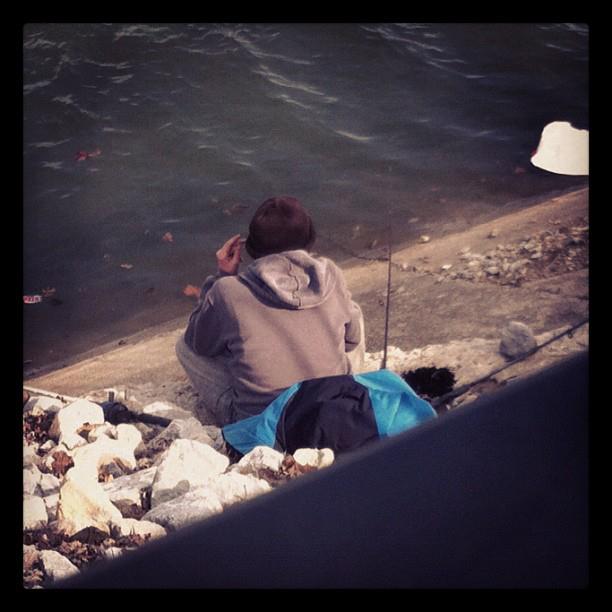
A Man Fishing, But I Am Not Sure He Caught Anything

Kayaking the White River: Looking at the Ball Mansions

“All water has a perfect memory and is forever trying to get back to where it was.”—Toni Morrison in Rita Dove’s Grace Notes

I, too, always feel as if I am trying to get back to where I was. In a way, we are all trying to get back to where we were.

New ‘Do, Decent Breakfast, and Some Thoughts About Sexuality Which Really Have Nothing to Do With Lent

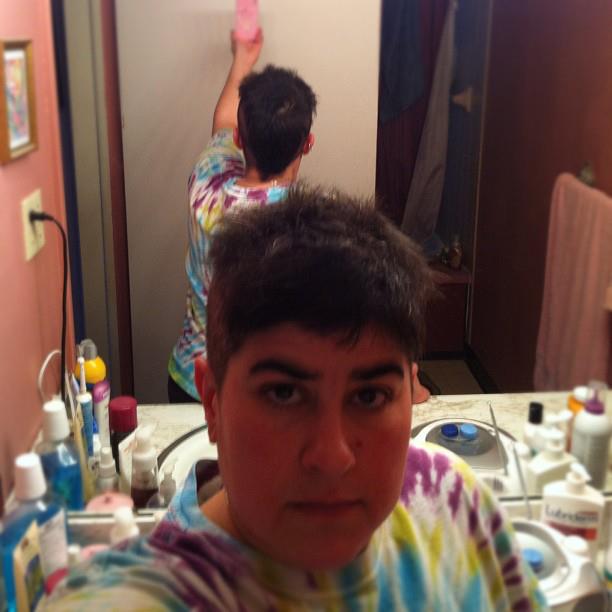
I want so badly to let my hair grow out, so I can give myself dreadlocks. I don’t think it’s ever going to happen. When my hair reaches a certain length, I find myself just wanting to rip it out by the roots or to shave my head down soft like a baby’s bottom and slick, too. Today was the day when I couldn’t take it anymore, so I got out the clippers and gave myself a wide Mohawk with a DA in the back. It’s weird and different from my usual self-inflicted trim. Before I went crazy about my hair, I made myself a delicious Spring Break breakfast, which I intend to do every day before I go to school to work on grading.

Two Soft-Fried Eggs, Bacon, Strawberries, and Chai Tea with Raw Honey

Hair From Two Ways

And a Cat Who Judges Me

Note: Now for a bit more of a serious subject. This is not complete, but is just a seed for a longer, more well-developed essay.

I’ve been thinking quite a bit lately about spirituality and sexuality, as I usually do. These two areas are important to me and intrinsically part and parcel of one another for me. In my life, they cannot be separated, nor can the soul and the body. I’m not going to get all theoretical in this post, but I do want to mention a couple of things I’ve been thinking about. I’ve heard many GLBT folks say that they knew who they were from a very young, but they just couldn’t tell anyone, they didn’t have words for it, or they were shamed into not talking about it. I’m not sure I fall into any of these categories, at least not until much later in my adolescence.

I’m not saying I couldn’t tell something wasn’t the same in me as it was in everyone else. I knew that pretty much from the get-go. But then again, I didn’t know it, too. I knew how I felt, but I didn’t know it was gay. I knew who I loved, but I didn’t have a framework for recognizing same-sex desire then, I don’t think. Looking back, I can name it for what it is. I can see how much in love I was with some of my friends. I can name my fifth and sixth grade English teacher as one of my first teacher-crushes. (Since then I’ve fallen in and out of love with too many teachers/professors to think about! Ha!) I can call my love, my desire what it is. Now. Could I then? I don’t think so, but I could feel it.
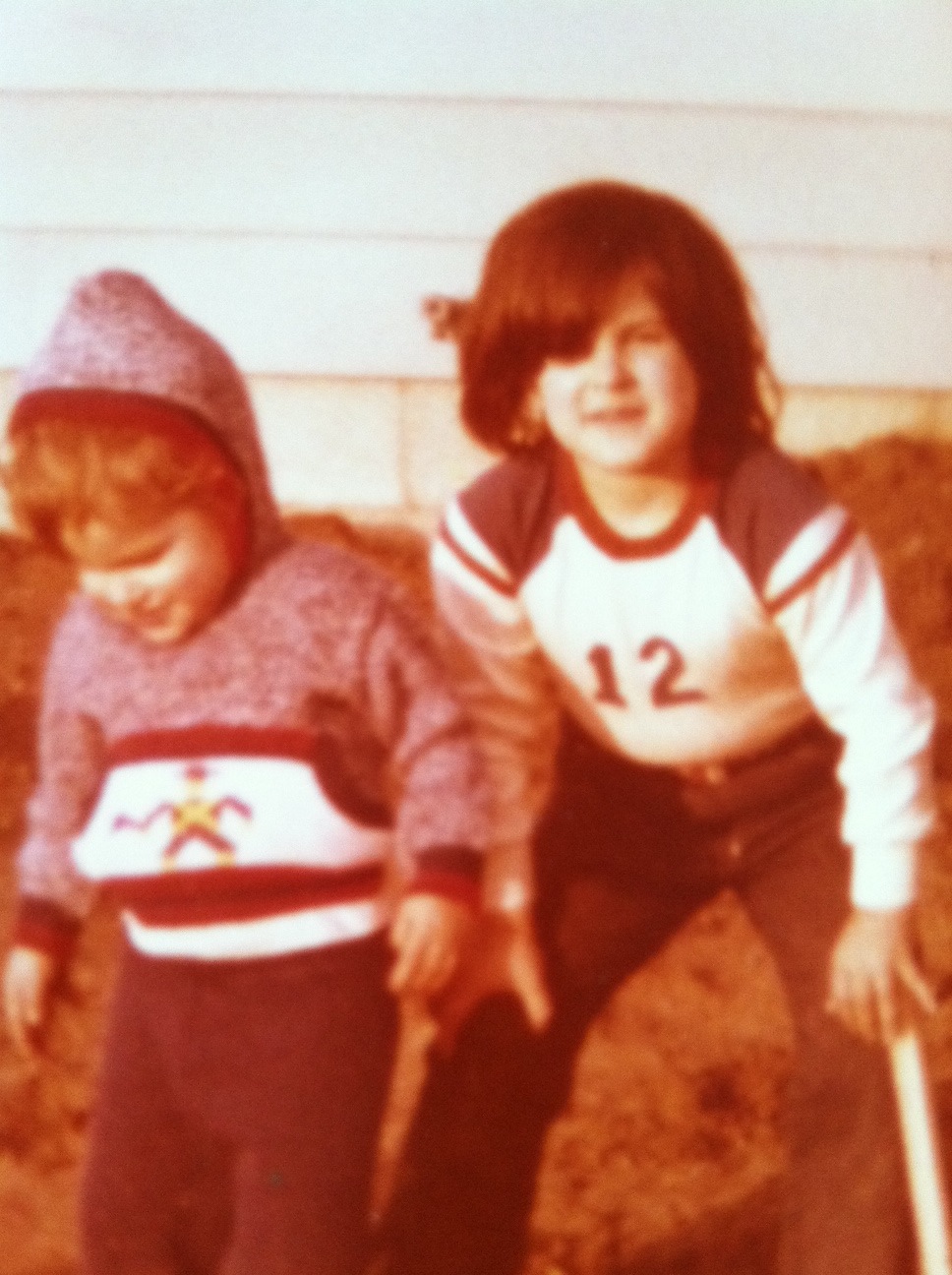
My Brother and I Digging in the Front Yard of Our New House

When I was in grade school, I knew I loved some of my friends. I knew I loved them much more or much differently than they loved me. I would share my toys, and I am pretty selfish. I would color pictures for them. I would take cookies for lunch with the sole intention of sharing them. I got jealous when they would spend time with other friends. I was heartbroken when I wasn’t invited to their slumber parties. I was devastated when one particular friend got a boyfriend and stopped playing with me on recess. I was crushed when I got in trouble for kissing another friend in kindergarten Sunday School. (Of course, the very next year, I got in trouble for kissing a boy at school. Maybe my problem wasn’t lesbianism, it was showing the kissing kind of affection!) Every adult message was telling me that the way I felt about my girl friends was wrong. Did I understand then? No. I knew my parents encouraged me to choose my own clothes, toys, books, and activities when I was at home, and I didn’t quite understand why I had to wear dresses to school sometimes when I preferred my jeans and t-shirts and tromping around in the woods. I suppose it was to make me seem more normal in the grand scheme of things, but then what’s up with this school picture? I was a butch little kid.

Somewhere Around Third or Fourth Grade

By the time I got to middle school, I was determined to be “normal,” even though I had a crew cut and relied on my FARTS University t-shirt, which I wore under most everything, to get me through the days. I think maybe why I like teaching middle school so much is because I felt so lost through most of it. I had one particular friend who was, for all intents and purposes, my “girlfriend.” I loved her, and I would keep on loving her through high school when we both had boyfriends, even becoming quite jealous when she got married and moved halfway around the world.
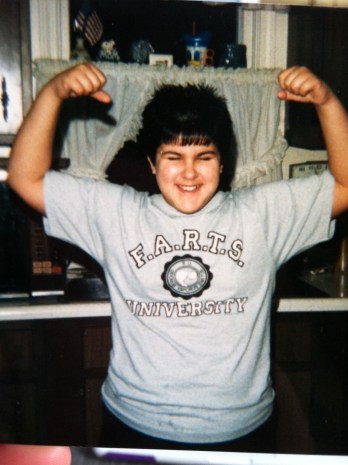
I had to wear this shirt under my other shirts, because it was "inappropriate."

I “went with” one boy all through middle school and into my freshman year. He was incredibly abusive and manipulative, leaving huge physical and emotional scars on my body. But I stayed with him because I had the intrinsic desire to be like what I thought everyone else was like, to be like what I thought I should. Everyone else had opposite sex significant others. Everyone else was making out in their family friends’ basement. Right, right? Eventually, during one of these “let’s play hide-n-seek so we can go lock our naked selves in your basement bedroom and make out” make out session, he forced me into having sex with him when I was just 13-years old, and I became one of many girls he date raped, or just straight up raped. The killing part of this was that he was two-years younger than I was. So much for being normal.

Looking back, I know now that my classmates weren’t all dating people of the opposite sex. I know that many of them were doing the same thing I was, putting on airs to make it through Blackford County Schools. Many of them didn’t date at all! There wasn’t room for people like us in that place at that time, so we played the game. It wasn’t that there wasn’t language for who we are. There was: fags, faggots, sissies, butches, dykes, unnatural, sinners, queers, homos, queerbates, gaywads, ACDC, swing both ways, and all sorts of other language that served to normalize us. Apparently, The Crying Game and Boy George made no impact on the small minds of Blackford residents. It wasn’t that we couldn’t talk about it, but we certainly couldn’t fathom our sexualities as positive, healthy expressions of love. And, of course, why would anyone bring on that ridicule by naming who they are?

I won’t say that growing up was particularly difficult for me, like I am sure it was with many of my friends and like it is for many kids now. I felt a sense of security in myself and my identity as a jock, artist, and nerd. I just threw myself into one of my acceptable identities, and I always have been confident in who I am. Perhaps, too, some of the security I felt in playing a part in the “Blackford County Play” was because I couldn’t feel free to say who I was, and by not naming it, I could pretend that wasn’t who I was. Besides I had a really for real romantic relationship with a boy, a young man, a beautiful soul of a man. He was a really for real high school sweetheart, who is a subject for a way different essay than this one. So I had a thick, thick closet door to keep me safe. In the same way the closet door kept me safe, it also stifled me until I finally came out. Slowly. Inch by inch.
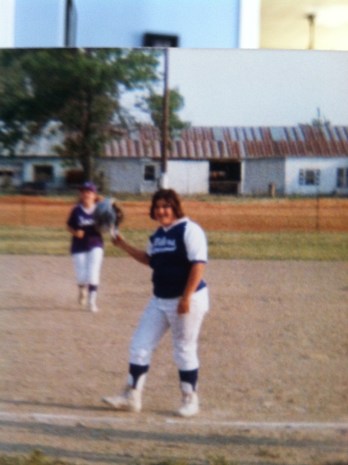
Softball. I played catcher, and if you don't laugh at that, it's because you don't get it.

And as I came out, I quickly learned that the most spiritual people in my life would have the strongest opinion about who I was becoming I was revealing to them. And, it even more quickly became evident that who I was revealing did not jive with who they thought I was, or should be. Never in my life have I had more Scripture thrust at me like a serrated and rusty knife than from the years of 21 to 23. I look back, and I think that Jesus must have been embarrassed. I know I was ashamed for the people who were beating me with a book I had previously loved, pouring so many teenaged years into studying it and getting to know my God. The God who had been my God through all of it and who still remains my first love.


Lent Day 12: A Long Drive

Today I had the good fortune of driving for about 5 hours by myself. And, yes, this is good fortune. I love a long, solitary drive. I can have silence to think about whatever I want. I can listen to music. I can sing (poorly) as loud as I want. I can take in the scenery. I can stop and get out and walk around if I want. And, I can listen to podcasts, which is exactly what I did today.

First, I listened to a couple of episodes of On Being with Krista Tippet. In one episode, she interviewed Rosanne Cash. I’ve never heard any music by Cash, nor did I know she was a writer and a physicist, but I was so impressed with her that I couldn’t stop listening as she described her process of making music as “catching songs,” a phrase I believe she credited to Tom Waits.

In the second episode, Tippett interviewed Tiya Miles who is a public historian, doing research about Cherokee slave holders and their African American slaves. Miles mentioned a line from Toni Morrison’s novel Beloved in which the reader is asked to consider a story that should not be passed on. Of course, Miles used it to frame her discussion of whether or not slave holding by Native Americans was a story that shouldn’t be told (passed on) or one that can’t help but be told (passed on).

What I love about On Being is that Tippett somehow manages to get every guest to relate his or her career, vocation, passion to spirituality, and she does it without being heavy handed or forceful. The exploration of faith or spiritual matters as invited by Tippett seems like a natural progression of the conversation, like the guests’ beliefs are so intrinsic to who they are, they can’t help but shape and formulate the interaction between them and their livelihoods, and that, in turn, can’t help but spilling out into the airwaves of the show. Krista Tippett has my dream job.

The next podcast I listened to was the Jesus Radicals‘ Iconocast where they interviewed Shannon Kearns, the pastor of the House of Transfiguration in Minneapolis. Kearns spoke about flattening the hierarchy, queer theology, and the ways in which the gospel is simultaneously intellectual and emotional. He also fielded questions about God and gender and the ways in which his own transgendered body informs his understanding of theology, the church, and God. Perhaps most interesting to me was his discussion of wounds and the way they record, they are the proof of, transitions.

This Seems Like a Queered Crucifix to Me

This was one of the better interviews they’ve done, and I think I may just drop by this church in a couple of years when we move to Minneapolis. While I admit I am nowhere near where the Jesus Radicals are, I very much appreciate their ministry, and I respect their beliefs. I especially love it when they help give voice to people who are helping the Church move in ways that are more inclusive to those who have been disenfranchised by the wider Church family.

Finally, I listened to T.C. Boyle’s “Rapture of the Deep” on Selected Shorts. Jacques Cousteau’s temperamental French chef plans a mutiny because he is sick and tired of preparing and eating poisson, poisson, poisson. My favorite part is when the chef beings making bad American comfort food, like macaroni and cheese or tuna casserole. Hilarious.

Peace.

Josh Garrels: Love & War & The Sea In Between

I’ve had this free download since a couple of days after it came out, but I haven’t really listened to it or any other music since school started in the fall. In fact, once school starts, the work for it is all consuming and I pretty much don’t do anything for myself aside from exercising and cooking, so I was pleasantly surprised when I listened to it last night while I was sitting on the couch reading magazine articles and blog posts on the Interwebs. Each song is presented in a different style, and yet retains the overall theme of grace and redemption and healing.Love & War & The Sea in Betweentakes the listeners on a quest or a coming of age journey, but I never did feel as if I’d left the sight of the shore. There is challenge and comfort in the lyrics in a way I don’t often feel in Christian music. Garrels asks us to be self-reflective, but always reminds us that there is comfort just around the bend.

“The Resistence” is somewhere between a rap and a spoken word poem, “Ulysses” uses the story of the Odyssey as the background for a beauty rocking folk song, and “Beyond the Blue” inspires the listener to look beyond themselves with lyrics like “Plumbing the depths to the place in between/The tangible world and the land of a dreams/Because everything ain’t quite it seems/There’s more beneath the appearance of things/A beggar could be king within the shadows,/Of a wing.” I could go on, because each separate track has its own feel and its own message or lesson. But, the lessons aren’t heavy handed. The tracks are so well-written, they make my writer’s heart smile. Poetic, poignant, and beautiful. Each song is simply a comfortable reminder to be who we are purposed to be. Challenging but comfortable, like walking and talking with an old friend.

Josh Garrels

ISTEP+

Today my students are taking the ISTEP+. I have a really hard time finding value in tests like these. My students have read, understood, interacted with, and reflected on texts that are so much more meaningful than those provided by the state for the purposes of the testing. My only hope is that they don’t get flustered. Every day before we take the test, I remind them what my mom used to tell me. “All I ask is that you do your best. I can’t ask any more of you than your best, and I certainly don’t expect any less.”

I think my problem is that these tests serve one purpose and one purpose only, which is to rank students on an artificial scale. They are, in my opinion, a means to a capitalist end, as are grades. If we rank and file students, then it makes them easier to control as adults. We can begin, at an early age, to sort them into who they will become.We determine through these tests who will succeed and who will fail. Though we claim that they do otherwise, they do not. They do not access how well the students have mastered what they have taught, they simply measure whose parents have shown interest in them throughout the school year, whose home lives are relatively stable, and whose creativity and ability to be intellectually curious has been sucked from them to the highest degree. They don’t want you to be creative. They want you to be drones.

Imagine an educational system in which students’ levels of ability determined what section of each subject they would attend, instead of their ages or grade levels. Imagine if students were encouraged at whatever level they function at, instead of constantly being forced to attain a level beyond their capabilities or below their capabilities, in some respects. Imagine a school in which a student’s age did not determine your curriculum, but his intelligence and interest level did. Imagine graduating student who had for all the years of school been asked to do their best because teachers cannot possibly accept less nor require more. What would this world look like if we leveled the very first playing field, education? There is plenty of time to be sorted out into the haves and have-nots throughout adulthood, but I think if we re-imagined education, we’d eventually close that gap.Of course, it might mean graduating students at the age of thirteen or fourteen if they’re intellecutally capable. Are we ready for that? No.

Because we’d no longer be in such drastic and marked competition with each other, we’d also place equal value on people who work in the service sector, recognizing that their abilities are just as necessary for our culture to function. A custodian who cleans the hospital, a housekeeper who does the laundry, and the nurse who creates the sterile environment, are just as important in a successful surgery as the surgeon who performs the task and gets the glory. Without the hierarchical form of education we now deem necessary, the surgeon may recognize at an early age that his success depends upon the success of his classmates.

There may also be an increase in students who don’t feel the pressure of going to college, who will choose to live a different lifestyle by taking a minimum-wage job and living frugally. Right now education is on a strange teleological path that ends with the heaven of the ivory tower, but what if we taught our students that there is more to life than being financially stable, owning multiple cars, a big house, and a summer cottage? What would happen then? What our students realized they didn’t have to buy into the nonsense that is the US capitalist economy? We just might end up with a few more geniuses.