Category Archives: Writing

Vacation and the Rest of Summer

I just learned that I start teaching at Burris on August 18th, which means I have approximately six and half weeks (not counting the week I will be gone to Nebraska and Minnesota) left to accomplish all of this:

  • finish painting the outside of the house (the floor will wait until next summer)
  • finish a chapter of my dissertation (or at least get a really good start on it)
  • work 20 hours each week in the IEI
  • start training for the marathon in November (once school starts add lifting weights and swimming)
  • go through all of the Write On! Featherweight stuff and get it together
  • plan for the entire school year next year (two seventh-grade, two eighth-grade, and one tenth-grade year curriculum plans)
  • play some disc golf, basketball, and possibly soccer (can someone teach me to play soccer?

Here is how I plan to accomplish all of it:

  • House painting—WEEKENDS
  • Dissertation—AFTERNOONS
  • IEI—MORNINGS
  • Running—EARLY MORNING before dog walking, must get up by 6
  • Write On! and Planning for School—EVENINGS
  • Disc Golf, etc.—IN BETWEENS

I am sure there is something I am forgetting. I am not sure I can accomplish all of this in 6 weeks. Say some prayers, breathe some for me.

*

My family (Dad, Mom, Adam, and I) just got back from vacation in Cincinnati. Cincannati is like dissecting owl pellets: you have to wait through the disgusting stuff to find the gems inside it. The majority of the city of Cincinnati, not the suburbs or the outskirts, looks like the worst neighborhood of most other big cities. We wanted to walk to Findlay Market, but the shuttle driver at our hotel said he’d better drive us because the neighborhood was so bad. I agree. Usually, I am unmoved by deteriorating neighborhoods. I am not afraid of loitering people, or run-down buildings, but this area of Cincy was more than just derelict. People had looks in their eyes that were so down-trodden, so forlorn, that I was afraid of them. They looked the way Cormac McCarthy describes people in The Road. That desperate. That carnal. While we were there, each morning the news reported several shootings within a couple of miles of the hotel. My dad couldn’t sleep because of all the sirens, and there were literally 50 or so homeless people sleeping on the grounds of the library across the street.

However, much like other big cities, if we stayed South of our hotel, toward the Great American Ball Park, there were no worries. In fact, there were multiple tourist attractions and affluent shopping malls, complete with Brazilian steakhouses and upscale clothing stores. I wish I could rest one day from thinking about culture. I wish the injustices and inequalities weren’t so blatant to me. Sometimes I just want to go back to not recognizing the painfully obvious way our society is stratified. I can’t though, so my heart hurts. I have a hard time having fun, but I have a hard time identifying how I can do anything to help a system so big and so broken. One of my constant prayers is for God to show me my role in helping to fix our very broken world.

*

Also, I found this amazing graphic to help me plan meals while I am training.
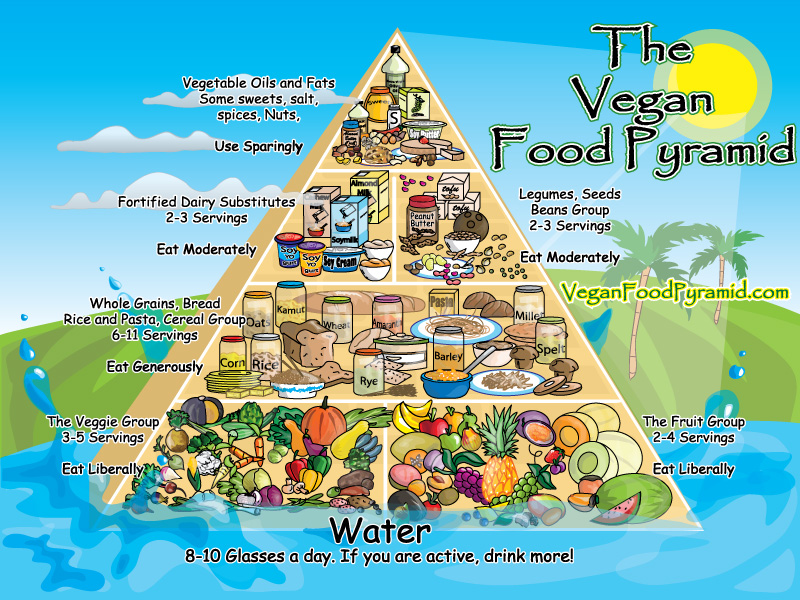
The only hard part about this pyramid is drinking enough water. Our water tastes pretty gross, and even though I know algae isn’t bad for me, I still don’t want to drink water that tastes like organic matter. Ew.

*

Food: banana, juice, sweet potato waffles with strawberries, blueberries, and a touch of syrup, carrots, cherries, tortilla with faux peanut butter and strawberry jalapeno jelly, a few Thai chips, chocolate soy milk, salad, guacamole and salsa and chips, cauliflower, blackberries, peach, veggie burger with bread,

Exercise: walked the dogs,

Blah. And some more blah.

I need to start writing here consistently, and I need to finish the two book reviews that I started when I was in Florida. I need to paint the house. I need to finish the floors. I need to plan for next years’ classes. I need to work on my dissertation and meet with Debbie tomorrow. I need to spend time running. I need to write my presentation for the PCA conference in October. I need to revise a couple of essays and send them out to try to get them published. I need to give time to my friends and family. It’s slightly overwhelming, and all of this in a summer that I thought might be relaxed. I need to not be so overwhelmed by all of my activities, commitments, and self-assigned bullshit.

But, first, I need to finish these end of course assessments for the IEI at Ball State, which is where I have a summer assistantship.I am having a hard time getting motivated because it’s a bit intimidating to make assessments for courses you’ve never taught and probably never will teach, though I’d love to teach in the IEI. I think it would be very satisfying. As for my summer work, it’s different. It’s challenging. It’s fulfilling.

It’s different because I have never considered how to teach a language in a very short amount of time to someone who doesn’t speak it, much less if that person is beginning college or graduate school, which I think are very different considerations. I am not sure that it is as important to teach a graduate student how to keep a daily planner as it is to teach the same skill to a 19-year-old college freshman. All college freshman should have to take a study skills class, regardless of their ability to speak English or not.

It’s challenging because I have some very definite ideas about what students should know when they enter an English 103 or 104 classroom, and my ideas don’t necessarily jive with what the IEI instructors can accomplish in their seven or eight courses, which I believe are taught in seven weeks each. I could be wrong. Anyway, the classes go from fundamental (or survival) through communicative to academic. My task for this week is to design reading assessments for each course to test the learning outcomes for each class. This task is challenging when I have only learning outcomes, and no real grasp on or feel for the students. I said today when I was talking to the director of the IEI that this is challenging for me because I view language acquisition to be a much more organic process than academia views it to be. Think about how you learned language. Did you ever take an end of course assessment? Probably not, but then again, you weren’t trying to acquire a language in a few short months; you had years to do it.

Finally, it’s fulfilling because the end result is that people are equipped with one more skill that will make their lives in the US a little easier. I can imagine nothing more intimidating than being in a new culture without having command of the language of that culture. I by no means believe that all Americans should be required to speak English; we are far too diverse of a culture to require that. I do, however, believe that going to school at an American institution requires that you be able to speak, read, listen to, and write the predominant language of that institution and to be able to do it well. Particularly, the humanities require this. I am still trying to decide if getting a science, math, or another non-language-intensive degree should require a command of English, since we are in the US (I suppose the predominant language at some American universities is Spanish, Portuguese, or French?). I am leaning toward no, but it’s up for debate. At any rate, this summer work is fulfilling, too, because it’s forcing me to have to reconsider all those things I think about language. And, I am learning new things every day. Very good.

*

I am at a point where I just want to lose weight, which makes me a very bad fat studies scholar. I love food too much. I love good healthy vegan cooking way too much. I could seriously eat all day long, but then I’d have to run all day long. And my foot’s been really funky, so I haven’t run at all, only walked. And not much.

*

I want to write a list poem about freedom, or imprisonment as outlined in Sarah’s post. I just need time.

The Naked Gospel by Andrew Farley

The Naked Gospel: The Truth You May Never Hear in Church by Andrew Farley begins with an epigraph by Arthur Bury from 1691, making the claim that the naked gospel “was the gospel which our Lord and his apostles preached,” which is what I expected this book to do. I expected to read a new take on Jesus theology, in which I would learn a bit more about what Jesus said and did and the ways in which those actions were revolutionary. I would have loved this book if that had been what it really did. What I got instead was a whole different story involving Paul, a Jew who supposedly grew to have no use for his traditional religious upbringing, and those people who came after Paul who also saw no need for relationship with the Jewish Scriptures. How, can I ask, does this present “the gospel which our Lord and his apostles preached”? Instead, possibly the epigraph should have been a quote from Origen who thought that Paul “taught the Church which he had gathered from among the Gentiles how to understand the books of the Law” and then ignore them. It seems as if Farley spends quite a bit of time discussing Paul and Paul’s aversion to his own tradition, which doesn’t seem like a Naked Gospel, but more of an interrogation of Paul. That being said, this book isn’t all bad; it just wasn’t what I expected.

Farley provides an excellent critique of our desire to remain staid in our own complacent following of hollow rules that we perceive make us good Christians. However, I am not sure that early Christians would agree with his reading of the meaning of old and new and the ways that he argues Christians are called to live a new life without considering the laws or the Jewish Scriptures. It makes no sense to advocate the very heavy disregard for the early Christians’ previous religious experience, especially because there is substantial evidence to the contrary. In fact, the very people Farley discusses—Peter, Paul, and the other apostles—did not leave the Jewish faith. They merely reconfigured their previous beliefs to fit with their newly acquired faith in Jesus as the Messiah. Particularly, Matthew adheres to his Jewish roots as he tried to convince both Gentiles and Jews that Jesus is the Messiah. Making such an adamant break from discussing Jewish traditions and religion is a major weakness of Farley’s text. I do agree with his assessment that Christians need to learn to avoid “the painful symptoms of un-necessary religion” (31), but does this need to be done by completely breaking away from tradition or previous manifestations of religious worship? I think not. Even Paul, who Farley quotes sometimes very out of context, references his own religious and secular traditions as well as the religious and secular leaders of his time.

The main tenet that Farley proposes with which I agree is the idea that we are free from sin. We are always already forgiven, and too many Christians don’t realize it. They are crippled by the perceived necessity to keep accounts of their sins and to compulsively ask forgiveness for those sins, sometimes to the point of unhealthy self-reflectivity and analysis. I love the song “Everything Glorious” by David Crowder Band, because it makes this claim so well. I think Farley is getting at the same question as Crowder: “You make everything glorious and I am Yours, so what does that make me?” According to Farley, “It’s important to understand that we’re joined to the risen Christ, not to a dead religious teacher” (180). I would even take this a step further and say that we are the risen Christ. Whatever is to be done on this earth now, is to be done through us as we are the manifestation of the work that Jesus did on the cross. We are required to be Christ to people: “Genuine growth occurs as we absorb truth about who we already are and what we already possess in Christ” (187). I concur.

In short, I liked this book because it challenges several commonly held beliefs in contemporary Christianity, such as the idea that we have to change who we are to be perfect Christians. As Farly writes, “Having Christ live through you is really about knowing who you are and being yourself. Since Christ is your life, your source of true fulfillment, you’ll only be content when you are expressing him” (194). I agree but my main complaints about this book can speak directly to this idea: what if the way you experience Christ living through you includes a love for and an adherence to those “Old Testament” ideas that he claims are null and void? Can we really claim that the naked gospel is a gospel void of any sense of tradition or Jewish scripture, relying solely on tradition and reason to inform our actions as Christians? I don’t think so. I don’t think this is really “Jesus plus nothing.” It’s more like Jesus nothing with a heaping helping of misread Paul. I would recommend this book, simply so people could wrestle through all of these ideas as Farley adeptly challenges the reader to think critically about a variety of ideas.

You can read this and other reviews of the same book at Viral Bloggers.

Motivation and Book Reviews

I haven’t been so motivated to write in my blog since I put it private in order to thwart those people who might take what I say here and twist it for their own evil purposes. I am really not paranoid. Paranoia would imply that I have an irrational fear that people are talking about me or that they are out to get me. My fear is not irrational; I have proof. There are people out there who delight in the misfortune of others, who are not above spreading lies or half-truths about people, and who I suppose have nothing better to do than make others miserable by maligning them. But good comes from everything.

I can use this time period of my sequestered blog in the fall when I talk about audience in my English classes. I would like to say that I write for the pleasure of writing, but this few weeks has taught me that I write for the pleasure of knowing that someone is reading it. Is this a bad thing? I think it can be. It can be detrimental to let yourself simply write for the pleasure of knowing that someone is reading it. Shouldn’t someone who aspires to be a writer write for the sake of the act itself? I plan to write and read for pleasure this summer, which may help this malady. School may be part of the reason I write for an audience. I wonder if too many years of writing things for other people to read in order to acquire a grade has ruined my ability to write for pleasure.

Today marks the day when I begin writing here again. I have three book reviews to do for The Ooze, which will be posted here. I have been putting them off because of all the other things I have had going lately. I hope they don’t decide I can’t get books and review them anymore. I’d be sad, even though I have only liked one of the three books I have reviewed. I think I would have liked the other two, but they were advertised as something they decidedly were not. Stay tuned for the three book reviews to pop up shortly. The books I will review will be A People’s History of Christianity: The Other Side of the Story by Diana Butler Bass, The Naked Gospel: The Truth You May Never Hear in Church by Andrew Farley, and Who Really Goes to Hell? The Gospel You’ve Never Heard: What a Protestant Bible Written by Jews Says About God’s Work Through Christ. The last book is by far the most intriguing, but they all seem to be a simple rehashing of all that’s come before them. We’ll see as I write three distinct reviews.

Things I Am Afraid Of or My Phobias

The title of this post sounds a bit like an essay that I would never assign to any of my critical writing classes, but it is one that I would assign every semester to any creative writing class I might teach. I think this is a fascinating topic for many reason. One: I think our phobias say a lot about who we are. Two: By writing about our phobias, we get to explore not only what we are afraid of, but also why we are afraid of it. Three: Who doesn’t love delving a little bit deeper into her own psyche just to find out that the irrational fears she faces everyday are possibly very rational. Here are my phobias that I would like to one day write about:

  1. Haphephobia: A fear of being touched—I don’t liked to be touched for pretty much any reason. I don’t like to hug people or to have them walk up next to me and put their arms around me. So, if you have ever received a hug from me, consider your self lucky.
  2. Vaccinophobia: A fear of vaccinations—I think vaccinations are a ridiculous waste of time and money. We have diseases for natural population control, and we have vaccinations so large pharmaceutical companies can make money. Plain as that.
  3. Scatophobia: A fear of fecal matter—I don’t mind my own poop, but yours better not come near me. Also, I have a dog who I think is scatophobic because he literally runs away from his poop every morning.
  4. Pnigophobia or Pnigerophobia: Fear of choking of being smothered—This actually also extends out into a fear of drowning. Really I am afraid of not being able to breathe: drowning, choking, asthma, suffocation, or strangling.
  5. Nyctohylophobia: Fear of dark wooded areas or of forests at night—This actually has more to do with a fear I used to have when I had my Jeep. Whenever I would have all the windows and doors off, I was always afraid a deer would jump in when I was driving past a cornfield. It would then proceed to bite me in the next or hoof me to death. Since I love to camp, I think my fear has more to do with the deer.
  6. Gephyrophobia or Gephydrophobia or Gephysrophobia: Fear of crossing bridges—This only applies to really high bridges in interstates: The Chicago Skyway, a bridge in Milwaukee, the bridge to South Padre, one in Corpus Christi, and one in Dayton.
  7. Emetophobia- Fear of vomiting—Seriously, I will bargain with God to keep from throwing up. Ew.
  8. And, probably my most serious fear whose name I cannot locate: falling through the upstairs  floor into the level below—When I lived in an apartment on any floor but the first, sometimes I would have difficulty falling to sleep at night because I would worry about my bed (with me in it) falling through the floor into the apartment below. I would imagine myself waking up in the first floor apartment with its inhabitants staring at me. Now, since our bedroom is just above the dining room table, I think that the bed might fall through and land on the table and then the whole lot of us will end up in the basement with the cat litter pans. Ugh.

So goes my list of irrational fears.

*

I am thankful for people who understand my idiosyncrasies.

Food: I ate everything in sight. It happens on the first day of, and the few days leading up to, your period. Sue me.

Exercise: See above sentence. I was too lethargic to exercise. Tomorrow, though, I am going to kick the heck out of five miles.