Tag Archives: Grace

Christ Has Risen: Happy Easter

I don’t know about you, but for me Easter Sunday always brings with it a great and overwhelming sense of joy. Lent and the 40 days of wilderness and darkness are over. Jesus the Christ has conquered death and offered the promise of new and eternal life! Is there any better promise, anything more hopeful?

We attended two very different, but equally meaningful Easter services today.

This morning as we walked to the outdoor sunrise service given by Lutheran Church of the Cross, I thought about my colleagues who look down upon Christianity because it isn’t rational or based in science. Several times I have been made, by my academic peers, to feel as if my beliefs stem from some sort of ignorance or naïveté, or that my willingness to believe in the Christian miracles somehow negates any intelligence I might have, minimizing the worth of my intellectual pursuits, as if my religion or my spirituality disenables me to participate in rational, academic thought. But, I don’t want my faith to be anything but faith. I don’t want the mystery to be sucked out of the Easter miracles by rationality or intellectualism. I want my Jesus to stay firmly in the realm of things I can’t prove, but that I know to be true. I don’t think my willingness to believe in miracles negates my ability to think. Nor does my ability to think negate the childlike whimsy with which I place my faith in Jesus who died, who resurrected, and who will come again. I consciously choose to place my faith in something I cannot prove. I have not been brainwashed, led astray by a band of scallywags, nor forced into believing some mumbo jumbo against my will. My faith stands with the resurrected Christ, and I eagerly anticipate his return.

As we walked to the Nature Area at Minnetrista, I also thought about how beautiful this creation is and is becoming. I looked around at my surroundings and spent time thanking God for the grass, the trees, the birds, the flowers, the insects, and all of those things which were surrounding me. We were laughing, holding hands, and anticipating the service at which we’d celebrate Jesus, his body broken and repaired, when we realized that the gate between the field we were in and the Nature Area where we needed to be was closed. Could we walk around? Maybe. But there was enough space for us to go under the gate, so on our way to Easter sunrise service we rolled under the big, black iron (steel?) gate. We thought the sight must have been hilarious, and we sort of wished we could have filmed it. The experience definitely put us in the right, good, and joyful mood that Easter calls for.
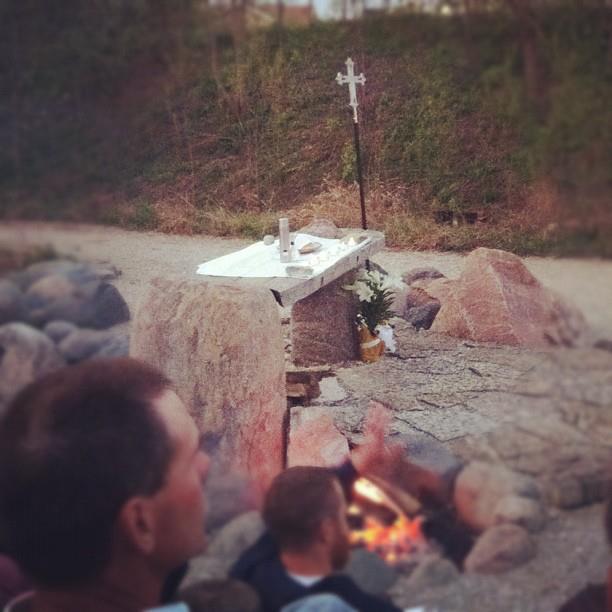
What We Saw When We Sat Down:
Communion and Fire Pit

My own Easter blessing.
I love it when the sun rises while the moon is still up.
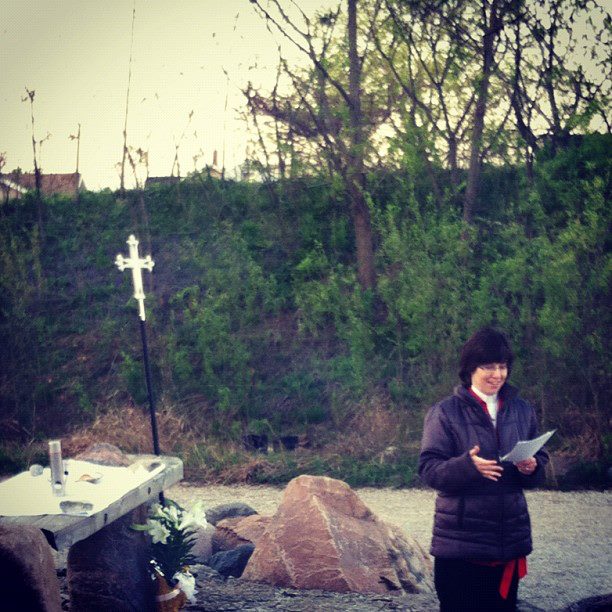
The Message

The message at the sunrise service focused on Mark 16 and the role of the women. Later I mentioned to Becky that the three times we’ve been to Easter services where women were officiants, they’ve preached from this passage. There is something so empowering about this bit of Mark’s gospel: the women were the first to know the good news. And there is something status quo about the same passage: they didn’t say anything because they were terrified. Whenever I have read or considered this section of scripture, I have always entertained all the possible reasons the women might be terrified. Were they worried that no one would believe them? Did they think people would think they had done something with the body? Were they afraid because the news they carried would turn an entire religious and cultural system on its head? Were they like so many other throughout history who have been afraid to speak? Were they afraid they’d be accused of blasphemy? Were they afraid at the greatness and glory of the news they’d just heard? Why were they so afraid they didn’t tell anyone? Of course, my really cynical side wonders if they did tell everyone, but then their story was stolen by men who wanted the glory of proclaiming the good news. I would suppose it’s a combination of all of these things, but it’s a beautiful thing that at least Mark’s gospel gives women the first knowledge of this new paradigm, even though they were too terrified to share it. This passage is one of several reasons that Mark and Luke are my favorite gospels, giving the role that women played in Jesus’ ministry fair exposure. I enjoyed being invited to think through these ideas again this morning.

Sculpture at Minnetrista On the Way Home From Sunrise

The Courtyard at Minnetrista on the Way Home From Sunrise

When the sunrise service was over, we went home and had a delicious breakfast of scrambled eggs with spinach and bleu cheese and bacon. At 10:30, we attended the church we’ve been attending for about a year and a half or so, Commonway Church. The service was in the usual style, but there were several baptisms and we had communion for the first time that I can think of since last Easter. Matt’s sermon focused on the history of resurrection theology as found in the Jewish scriptures, and he encouraged us to remember that we have a resurrection coming. He reminded us that Jesus shocked the disciples by proclaiming to be the embodiment of the resurrection, essentially the embodiment of their future. Jesus was saying, “Your hope of the coming age is in me,” reminding us that Jesus Kingdom is the already, but not yet Kingdom of God. As a bonus, we sang one of my favorite songs: “Lay ‘Em Down” by Need to Breathe.

It is won. It is done.
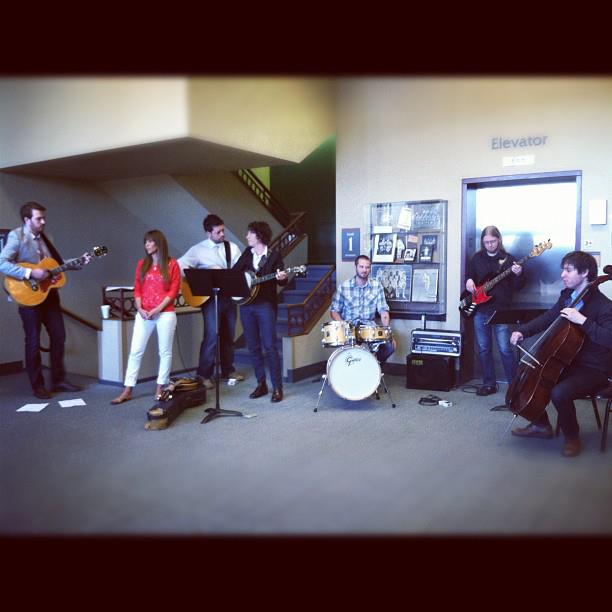
Our Easter Gift from Commonway's Band, A Lobby Concert

Each of these sermons spoke to me on a different level. Obviously, the first sermon spoke to me as a woman, reminding me of the critical role of women in the Kingdom of God. The second reminded me of the strong Jewish theology that Paul used to explain the work that Jesus was and is doing here on this earth.

Lent Day 31: Being a Grown Up Sucks Sometimes

Today’s weather was perfect for a run: 70 degrees with a nice lukewarm rain. As I came home from school today, my heart wanted so badly to go for a nice, long run. My spirit wanted to be unleashed and untethered to plod along the Greenway with my bare feet soaking up the rainwater as they splashed along the trail. I could feel the joy in that run.

I sat by the open picture window, looking out across the green floor boards of our front porch and watching the rain fall in the grass of the front yard. I admit that I have been feeling a little sorry for myself for the past month. My body doesn’t seem to have the same aspirations as my spirit when it comes to running or swimming. For example, today instead of wanting to go run, my body wanted to come into the house and fall asleep on the couch by about 5:30.

I’ve been sick quite a bit in the past month, and I wouldn’t say that it’s been a serious sickness. I’ve just been tired and haven’t felt 100 percent. This week, however, just when I wanted to really kick in my running to get ready for this 15K trail run, my body decided to rebel. I’ve had a temperature as high as 101 degrees, and I can’t seem to shake it. Of course, some antibiotics would probably help, but I don’t like to take medicine. Apparently, I’d rather wallow in my own illness than do something about it. How theological is that?

Along with not being able to run tonight, like I wanted to, I also wanted to go to Hartford City to see some bands—The Whipstitch Sallies and So What and the Deliverance—perform and to spend time with some friends. I have been planning to go hear them for several weeks, if not months, so I was really disappointed to not be able to go. But I decided that I am old enough to have to cancel some things when I am sick, which is kind of a big deal for me, because I tend to just keep going until I drop over. In fact, that’s likely why I am sick right now. Last weekend was a doozy, and since the end of February, I have been going nonstop. I’ve been going so nonstop, I was shocked when I looked at the calendar today and realized that April is literally a week away. I’ve missed March somehow. Time generally goes too fast for me anyway, but this was ridiculous.

Somehow I also missed the fact that the Huffington Post Religion section is running a special page for Lent 2012. Do they do this every Lent and I’m just oblivious? Probably.

Each day there is a meditation provided by one person from a diverse group of religious leaders and writers. Some of them are very moving, so I would suggest simply going there and perusing them if you’re so inclined. This one by Rev. Emily C. Heath was one of my particular favorites, and this one by Carol Howard Merritt is a particularly beautiful story of the grace of feet washing, to which I can thank my Church of God friends for introducing me. Enjoy the contemplation.

Peace.

Lent Day 20: School’s Back in Session

I know what it feels like to be a balloon and to have the helium sucked out of you, because that’s what going back to work did to me today, only with joy instead of helium. As of Sunday, I felt nearly completely joyful. I felt as if I could conquer the world. I could literally feel myself beginning to be positive about many things. And then I went back to school today, and everything was the same as it always is, and there was too much to bear.

My day began with the computer cart I had reserved not being plugged in for break, so all the computers were dead. I resorted to my backup plan, because I always have one of those when I am supposed to use technology in a lesson. Everything turned out fine, but I was, for some reason, still annoyed.

My day continued with one of my students pretty much straight-up lying to another teacher about whether or not I make them do citations for my class. Luckily it was my lunch, so she had me come over to her room to put the citation information up on the board for the students. He tried to weasel his way out of it by playing it off in his clowning sort of way. It didn’t work.

My day continued to continue with one of the counselors telling me that some of the students think I am mean this year, not at all how I was last year. My response was to ask her if the students realized that their behavior was part of the reason their teachers can be grumpy. Basically, I played it off on them, like a jack ass.

Finally, I finished my day on a positive note playing racquetball with Celeste, which is always a great time. When we play, it doesn’t matter so much who wins or loses, but we talk, we do the dozens, and we let our frustration. And somehow, though she likely doesn’t know it, I always learn from Celeste. I always leave a little more calm, with a bit better perspective.

While I was making fish stir fry for dinner, I stopped…

and thought about how I have been with my students this year, and how I have let my anger creep into everything I do.I have been shorter with them, and I could make excuses, but there really is no excuse. I thought about how I have short-changed not only my students, but also my friends, my colleagues, and my family because of my bitterness with God, and my general anger, though I still cannot pinpoint the source of the anger that overtook me.

I thought about how my first response was to blame my students, my 12 to 16 year old (well, a couple of repeat offenders who are 17) students for my shitty behavior. They are children, young adults, and my behavior, as a grown woman, should not be dictated by their level of participation, their willingness to think that English is the best subject ever. (It is, though.) My behavior should come out of, or, to use a really bad creative writing phrase, it should flow from my own moral and ethical belief system, which is not to take my anger out on those around me.

I’m not above being all “Hallelujah, Jesus Freakish” when I say that since I’ve reevaluated my Christianity (and added in some Buddhist thought, too) I am ashamed of some of the ways I’ve behaved while I was out there in the wilderness (yet again, damn I wish I’d learn one time). The biggest shame I face is the fact that I have treated people in a way that nowhere near resembles Christ’s love, but it, instead, resembles the “GOTCHA” mentality that is so prevalent in our culture, where people just sit in wait for others to screw something up, so they can call each other out on it. There has been no cheek turning for me, unless it has been me turning my cheek and hiding my mouth behind my hand, so people can’t hear what I am saying about them. Seriously, it’s been bad. I needed that reality check today.

So, today, I am asking you all for a little bit of accountability. I want to be filled with God’s grace, sharing it with all those around me, especially my students. And I want to follow that old saying from Eleanor Roosevelt: “Great minds discuss ideas; average minds discuss events; small minds discuss people.” I want the words of my mouth, and the actions of my body to glorify God. I no longer want to conform to the patterns of this world, but I want to be transformed by the renewing of my mind. I want to be the teacher my students remember for being loving and gracious, and if I’m lucky, they’ll remember some of the language arts I teach them, too.

Peace.


Lent Day 15: Healing and Learning

During my morning prayers, I am also reading Reluctant Pilgrim. In the chapter I read this morning, Okoro writes about a man she was in love with, and unless her words betray her, I would say still deeply loves, or at the very least remembers fondly. She writes about his addiction in these words: “God’s light shines especially bright through the multiple and endless fragmented slices that exist in broken people. And the more rays of light, the more people are touched. But no one expects such light to come from a broken image. I learned to understand the radical beauty of God through Michael’s shards. I learned to acknowledge the beauty of God through my own brokenness” (77). When I read this beautiful description of brokenness, I realized why I have always loved that churches use stained glass to tell the biblical narrative.

Maybe the early stained glass artists were onto more than simply reappropriating the technique of mosaic with a new technology. The multicolored shards of glass work together to not only reflect and refract light, but they tell one cohesive story of beauty and grace. Each piece of art, carefully rendered with fragmented pieces of glass held together by that thin lead casing, each piece of art tells a beautiful story and needs each small fragment to tell it. I should look toward the stained glass to tell me about more than a biblical narrative; I should ask the stained glass to tell my own narrative, and to remind me that we all work together to form the body Christ, as weird and multicolored as it can be.

A few pages later Okoro writes: “I want to find a church that teaches me something about carrying each other’s burdens, about living into the gift of God’s grace so we are free to be the persons and community God calls us to be. […] Maybe I love the image of U2’s ‘Grace’ because it reminds me that God our mother eternally supports and nourishes us and, most importantly, does not punish us for being the needy creatures God created us to be. […] I don’t imagine that I extended grace to Michael. That would be presumptuous. Rather we both got caught up in the delicate but strong grip of God’s grace, that sense of divine love extending outside of God’s self and demanding humility from whoever falls into its arms” (80). I love this idea that we don’t extend grace to each other, and I never thought about how presumptuous it is to assume that we know anything about grace at all.

The idea that we just get caught up together in God’s grace is a profound one for me. I have always thought about giving grace to people, but not about mutually receiving grace, thought that’s exactly what happens. In fact, once I read this passage, I thought about Jesus saying that it’s better to give than receive. Why? Because when we give, we are simultaneously receiving. We can never only give grace, because what enables us to give grace is God’s giving of grace to us. We are inextricably caught up with others in giving and receiving grace.

In addition, maybe a lesson I am supposed to learn this Lent is one of humility. In the argument with my friend, humility was a learning point. In chapel yesterday, denial is a form of humility. Here, today, I learn that grace requires, no demands, our humility. How beautiful! If simply keep asking, God, what do you want with me? I have no doubt that I will eventually learn what it is God desires. I have no doubt that I am supposed to be a shard in the stained glass body of Christ.

Click the arrow below to listen to Nichole Nordeman’s cover of “Grace” by U2. You’ll also have to click the same arrow on the MySpace Music Player.

Grace (In The Name Of Love Album Version)

Lent Day 6: Joy and Confession

I am sure you are thinking, What a strange juxtaposition for a title! Joy and confession? How do those two go together? I am not entirely sure theydogo together completely, but I can tell you that I am beginning to experience pure joy again. I find myself laughing with reckless abandon more, and I find myself getting incredibly grumpy and sad less. And it hasn’t simply been the past six days while praying three times a day, following the liturgical hours; this joy has been slowly growing—like the bright green moss on the hillside by the river—since the new year started. I posted the other day, maybe yesterday, how I feel like I am finally taking control over my moods, rather than them controlling me, but just today, I felt complete joy. I actually threw my head back and laughed my big belly laugh. And I wasn’t embarrassed by it. Which, in turn, gave me more joy. I am no longer the shadow person I have been.

Part of my joy comes from observing Lent and knowing that in a few short weeks, we’ll be celebrating the resurrection of Jesus. But another good portion of my joy comes from suggestions picked up from Pema Chodron’s The Wisdom of No Escape and the Path of Lovingkindness. InWisdom, Chodron advocates making friends with those parts of us that cause us anger, aggression, or aversion, because those attributes that irritate us about others are the same that irritate us about ourselves. Through the act of making friends with those attributes, and no longer trying to rid ourselves of those attributes, we learn to give kindness to others. Our desire to rid ourselves of those qualities results in an aggression toward those qualities when we see them in others. We become unkind to both others and ourselves. Because Chodron teaches how to be kind, I feel like I can begin to honestly look at myself and decipher what it is that I don’t like about myself, recognize that those features are simply part of who I am, make peace with that, and eventually stop trying to remove those attributes from myself and from others, thereby gaining a kindness and a sense of peace in regards to myself and others.

(Side note: My next spiritual read is Thich Nhat Hahn’s Living Buddha, Living Christ.)

How can Inotexperience joy when I have made friends with my whole self, with all of my attributes?

This is where confession comes in. First, I must closely self-examine to figure out what those attributes are that I don’t like about myself. Once I decipher that, I must confess those qualities to myself, to others, to God even. Through this confession, I name my weaknesses or those things which cause me pain. I claim them out loud. I call them what they are. Then I make friends with them, not “comfortable, hey let’s go have some pizza and beers friends,” but I acknowledge that those qualities are a part of who I am, and I sit with them. Get to know them. Make friends, like “sitting on opposite ends of the couch, but I am not trying to kick you out” friends. My weaknesses and I learn to coexist after I confess them. And through our coexistence they eventually cease to be a cause for anger or malice or injury. They just are.

I confess that there are a whole bucket of attributes of my personality of my life that irritate me, that I need to make friends with. And I hope that once I make friends with those facets, they will just sit at the other end of that couch and be quiet. That’s my biggest flaw: I don’t know when to be quiet. Maybe I need to take a silent retreat. Every day. One of the things I appreciate about this Buddhist idea of embracing our own flaws is that I don’t end up with a bucket of shame at what I’ve confessed about myself. I end up, instead, with a changed heart. Too many times, Christians miss this bit and would rather shame someone than encourage their wholeness. That, in and of itself, is a shame.

This whole discussion brings me around to what prompted these thoughts. Part of the evening prayer, which I have been praying for six days without recognizing this part, says, “You are worthy at all times to be praised by happy voices, O Son of God, O Giver of Life, your glory fills the whole world.” I think this part jumped out at me tonight, because for the first time in a long time, my heart feels light and joyful. I’m going to cling to that joy.

Peace.