Category Archives: Relationships

Cultivate Joy: Part Two (St. Bernard)

I am slowly coming to realize that joy is not necessarily an outwardly expressed, chipper, I-am-so-happy-because-everything-is-fine type of feeling or attitude. Joy is an inwardly felt, deep, intense, I-am-so-connected-with-Jesus-I-can’t-help-but-feel-any-other-way-(at this moment)-and-I-can’t-help-but-share-this type of feeling or attitude. And, it seems as if everything I read about joy indicates that it’s cyclic. Of course, the goal is to be in a permanent state of joy, but because we have other human emotions, the permanence is varied depending upon the presence of those other emotions.

For example, according to an article by Sylvie Supper titled “Spiritual Joy in the Works of St. Bernard,” St. Bernard believed that joy is one of four inner movements. The other three are sadness, love, and fear (361). Supper quotes Bernard’s own writing: “If sadness follows fear, it brings despair. If joy comes after love, it brings laxness. Let joy then some after fear, for fear dreads what is to come, whereas joy finds happiness in what is present and possesses the object of a prudent security. Joy must therefore put fear to the test. And a tested fear is nothing but prudence. Sadness must follow joy, for whoever remembers sad things will embrace joyous things with moderation. Thus sadness must balance joy, and a balanced joy is nothing but moderation” (361-2). The part of this statement that resounds with me is this: “Joy must put fear to the test. [. . .] Sadness must follow joy, for whoever remembers sad things will embrace joyous things with moderation.” I find myself telling my students that bad things happens in order to help us recognize the beauty and grace that surrounds us every day, but St. Bernard says that remembering sadness will help us “embrace joyous things with moderation.” What that says to me is that if we remember sadness, we’ll realize that joy is temporary and subject to change. We won’t let ourselves be swept away by joy, but we will realize the beauty of that joy, because we remember the sadness we’ve experienced as well. On this earth we must recognize there will be highs and lows. We should expect them, and remember each to temper the other. Now I feel like I am talking in a circle: joy, sadness, joy again, sadness again.

In order to illustrate the various types or levels of joy, St. Bernard sets up an excellent metaphor involving drinking: a taste is the joy of God we can experience during life, drink is the joy that is experienced by the souls of the saints, and inebriation is the experience of joy at the resurrection of the body (364). In this life, we can only taste; we can’t become inebriated. He quotes Psalm 35: 9, but I think both 9 and 10 help to better explain this idea of the inebriation of joy: “Then my soul shall rejoice in the Lord, exulting in his deliverance. All my bones shall say, ‘O Lord, who is like you? You deliver the weak from those too strong for them, the weak and the needy from those who despoil them.'” It’s as if the speaker’s entire body is steeped in deliverance, and why would that not bring an intoxicating, inebriating joy? “All my bones shall say” I am filled with the joy of the Lord. How many times has my whole body said, “I am inebriated with you, Lord”? Not yet. Not here. St. Bernard, much like John Wesley from the last post, says that inebriating joy will come later, that it’s not this-worldly.

Jubilus cordis is “the very music of the heart,” which is only found when our hearts experience “the deepest and most intimate joy of the soul united with God” (366). This intimacy is given to us through the books of Proverbs, Ecclesiastes, and the Song of Songs, and it is felt as if from an intimate couple, such as two individuals who marry or who are deeply, intimately bound. Supper says that this intimacy “is a certain experience of God that communicates to the soul [God’s] sweetness and the joy of [God’s] presence” (366). This reminds me of the song “You Are So Good to Me” by Third Day. The chorus says, “You are beautiful my sweet, sweet song,” which seems like a version of this intimacy with Jesus that’s prevalent in Song of Songs.

Finally, Supper explains that though St. Bernard focuses on the inner workings of joy, joy cannot help but radiate our from us. We should have a desire to share our inner joy with others. So, for Bernard, as for Wesley, this inner attitude becomes an outward attitude. Something we just can’t help but share. I suppose first you have feel joyful inwardly, which is my difficulty. I’m not sure if I should expect this joy that can’t help but radiate to be a knock-me-down kind of joy, or just this occasional sweet, peaceful, sort of pukey feeling I get in my soul when everything seems to be right with God. I think it’s the second one, because it seems to be tempered with fear like in the first part of this post, but I also think St. Bernard thought it was the first one, too. Joy is subtle and joy is blatantly obvious. Basically, joy boils down to, again, a relationship with God. Joy is part of the fruit of that relationship. It’s a part of the fruit I wish I could taste more frequently. I want to be inebriated with joy. Here. Now. I don’t want to have to wait for it. I’m the Veruca Salt of the spiritual fruit: I want it now.

*

Supper provides a nice little glossary of terms St. Bernard uses for joy:

  • gaudium: signifies all kinds of joy
  • laetitia and exsultatio: signify the exultation of those who have found God, opposite of bitterness; confiteor: the praise of whoever gives thanks to God
  • hilaris: one who gives joy, the radiation of the face
  • jucundus: someone who leads another to joy
  • congratulatio and congaudere: shared joy
  • alacritas: fervent and driving joy
  • delectare: delight found in resting in God
  • jubilus: the inner song of the soul united with God

Cultivate Joy: Part One (John Wesley and Mother Teresa)

My first goal of 2013 is to cultivate joy. In my last blog post, I wrote that in order to cultivate joy, I would “do things which me bring me joy. Embrace the random. Enjoy the mediocre. Don’t stress over things I can’t control. Live in the moment and revel in those I spend my time with. Put down my phone or my other distractions and really love and live the moment.” For me those are the beginning steps to cultivating what I perceive to be pure joy. Because I am not the most joyful person, I decided to learn from what others have written about joy. What is joy? How does joy work? Is joy the same thing as happiness? Is joy what some mystics call ecstasy? Is joy something that one must experience every day in order to be considered joyful? I suppose I had (maybe still have) many, many questions about a theological, psychological, and behavioral characteristic I claim I am going to cultivate this year.

I intentionally used the word cultivate for what I intend to do with joy. There are really three types of cultivation. One type is more like refinement, which would require that I already possess some amount of joy that I simply plan to nurture and shape into much more mature, refined joy. This is not the type of cultivation I will be accomplishing. I will be using a combination of the second two types of cultivation: improving by the care or study of joy and fostering the growth of joy.

Much like a farmer cultivates crops in a field or a scientist cultivates specimens in petri dishes, I plan to plant, encourage, maintain, and harvest this joy. I plan to do the backbreaking work of starting from the ground up, digging little holes, planting little joy seeds, growing little joy plants, and then harvesting whatever little joy flowers or fruits grow from those plants. This is a whole new endeavor, and I didn’t even buy crop insurance. I’m not sure this is the sort of thing that can be insured. I’ll either come away with a bouquet of flowers or a peck of fruits from this year of cultivation, or I won’t. The pursuit of joy is mostly up to me and my willingness to work for it. Sounds weird: work for, cultivate joy.

Similarly, much like I have studied for the past few years to cultivate my knowledge of literature, I hope to study to cultivate my understanding of joy. I started by reading four articles, which is of course where I would start with this damn rational mind I’ve been given, but I plan to pay more attention to those people in my life who seem to be joyful. How is it that they can experience joy, when there is so much sadness, so much angst, and so much depravity in this world? Do they maintain certain habits? Do they hold certain attitudes? Do they rely on their spiritual lives, whatever religion or non-religion they may be? How do they seem to be so filled with joy?

Naturally, I first turned to John Wesley for thoughts about joy. Not because he was necessarily a joy-filled man, but precisely because he strove toward joy and sometimes fell short, did I turn to Wesley for wise words about the topic. In the article titled “John Wesley’s Moral Pneumatology: The Fruits of the Spirit as Theological Virtues,” Joseph William Cunningham writes: “The cultivation of spiritual virtue is abstract from community. Believers develop the holy tempers of righteousness, love and peace in relation to their neighbour. The fruits of the Spirit, though inward dispositions of the soul, are always socially oriented” (284). When I read these lines, I had three thoughts. First, I was elated that he used the word cultivated because that’s my word! (:)) Second, I was thrilled that he used the virtue, because when I was writing my goals for this year, I had in the back of my mind Ben Franklin’s thirteen virtues. Third, all theological concepts work best, and are meant to work best, when practiced in community. We are not designed to be solitary beings.

This photo was taken from http://anglicanhistory.org/wesley/. This photo was taken from http://anglicanhistory.org/wesley/.

On a more serious note, I really was elated when I saw these lines, but it was more because it has always seemed that joy is an inwardly focused theological concept; joy is about how I feel, right? The above quote made me think of the many ways in which joy is much more outwardly focused. Though Cunningham doesn’t list joy here in this passage, I can’t help but think joy comes in community, that joy is an “inward disposition” that should be “socially oriented.” I’ve experienced joy in my life, and usually that joy was felt in community. I have been in love, which was joyful. I have won competitions, which was joyful. I have experienced God, which was joyful. I’ve sung spirituals and released my pain and suffering, which was joyful. In every situation, while I was the person experiencing the joy, there were others experiencing it with me. I am not sure I have ever experienced joy alone. And if I have, my first inclination was likely to share that joy.

One reason I may not be the most joyful person is that I abhor those shiny, happy Christians I grew up with. Seriously, you can’t possibly be that happy all the time. Joyful? Maybe. Shiny happy? I doubt it. I was thrilled when I was reminded that Wesley struggled with the concept of continuous joy. Later in the same article, Cunningham quotes Wesley: “A will steadily and uniformly devoted to God is essential to a state of sanctification, but not an uniformity of joy or peace or happy communion with God. They may rise and fall in various degrees; nay an may be affected either by the body or by diabolical agency, in a manner which all our wisdom can never understand or present” (285). In other words, all of those people who told me I had to be happy to show my Christian faith were wrong. My will has been constantly (or nearly so) devoted to God. Only the outward signs of the fruit of the spirit have wavered. We, in this lifetime, cannot be filled with “love, joy, peace, patience, kindness, goodness, faithfulness,gentleness and self-control” (Galatians 5:22-23). We are human, yes? Perfection is something to be attained.

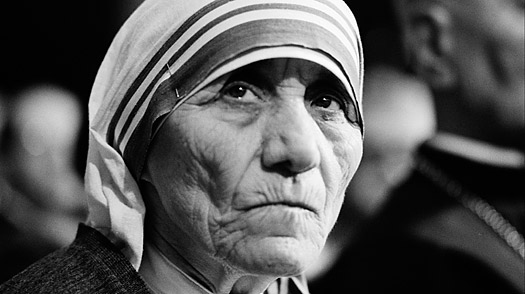
My quest for an understanding of joy was likely fueled by reading An Unquenchable Thirst. Much like the author Mary Johnson, I fell in love with Mother Teresa when I was young. A drawing of Mother Teresa with the words Living Saints in large, bold letters graced the cover of time magazine when I was about 18 months old. There is no way that image could have impacted me like it did Johnson, but I grew up having a knowledge of saints (likely from my mom’s Orthodox family) and having a certain reverence for Mother Teresa. I read everything I could about her, and I believed I had been a nun in a former life (okay, really I still believe it). There is simply something that appeals to me about living with other women whose thoughts are directed toward God and others; there is something that strikes a chord within me when I think about regulating my day with service and prayer. I have always thought that I might experience more joy in a place that was filled with Christ’s love.

This photo was taken from http://topics.time.com/mother-teresa/. This photo was taken from http://topics.time.com/mother-teresa/.

When I read Johnson’s book, I learned what I knew deep down: sometimes things aren’t what they seem. I had always assumed, until the August 2007 Time Magazine article,  that Mother Teresa was the most joyful woman on earth, and if I believed what Cunningham writes about Wesley’s thoughts of joy she might be: “Joy is a theological virtue implying habitual self-sacrifice and service of neighbour, even in the midst of sorrow and despair. The desire to love and serve is animated by true joy in the Spirit, and cultivated through commitment and practice” (286). Half-heartedly I agree with this. Before I read Johnson’s story, I (maybe) would have whole-heartedly agreed with it. Joy seems to be fed by giving to others, but I worry, now, if giving everything to others renders us not joyful but broken. Theologically, I suppose that very brokenness is where some folks would say that God works when we can’t. You know, the “Jesus works through our brokenness” idea? I am not sure I can buy that line of reasoning anymore, not the brokenness reasoning, but the idea that if we sacrifice and serve, we’ll be joyful. In fact, Wesley himself writes: “Yet it cannot be denied that many times joy is withheld even from them that walk uprightly” (Cunningham 286). Does pouring one’s whole self out into others and loving and serving provide joy? Yes, but not always. No, but sometimes. Maybe.

So, here I am at the end of my first consideration of the cultivation of joy, and I have studied and learned what one person thinks about joy. After thinking about how to cultivate joy, do I feel more joyful? Not yet, but I am hopeful.

The End and the Beginning

New Year’s Eve asks us to look back into the past year in order to assess where we’ve been, and it simultaneously begs us to look forward with hope that our future is brighter than, or at least as bright as, our past. Everybody and their brother is posting their reflections and their resolutions, so I figured why shouldn’t I. At the very least, this post will give my friends a heads up about the resolutions I’ll be breaking come January 3rd or 4th.

Obviously, if you’ve read this blog in the past year, you’ll notice that the past 365 days haven’t been a cakewalk for me. While my life has been incredibly blessed, I’ve had a really difficult time recognizing my blessings and reveling in them. My goals for this year in no particular order were:

  1. Eat paleo.
  2. Watch less TV.
  3. Exercise in a variety of ways (including swimming) while running (barefoot) a race a month.
  4. Meditate.
  5. Read more, including the Bible and Common Prayer.
  6. Play and find my inner hippie again.
  7. In short, do things which bring me joy. Relax.

Listing my goals out like that reminds me of Benjamin Franklin and his list of 13 Virtues or John and Charles Wesley’s tabulations of their moral behaviors. I suppose if I am going to list my resolutions or goals, I should keep track of how well I am doing with them in some manner. I don’t. I ate mostly paleo and lost about 50 pounds (I did gain some of that back this holiday season!). I can’t say I’ve watched less television; in fact, I may have watched more (Oh, Mariska, how you tempt me!). I did exercise a lot, but not as much as I would have liked. I finished my first triathlon, so that’s pretty decent. I totally left out meditation and prayer for a good portion of the year. I felt so disconnected, and I am not sure whether my lack of meditation caused the disconnection, or if I didn’t meditate because I felt disconnected. Either way, I didn’t spend enough time alone with my thoughts and God. I read a lot more, but not the specific texts I mentioned I would focus on. I played more, and playing was lovely. I did things which should have brought me joy, but they didn’t always. Instead I feel as if I just focused on the negative, even when I swore I would focus on the positives. I’m a realist; it’s difficult for me to be to be positive. I am going (to try to) to fix that this year. #PollyAnna2012 will become #joyful or #merrymaking or #radicaljoy for this year.

In short, I want this year to bring less of this:

535465_10100890792332028_552955746_n

And much, much more of this:

309358_10100711963581278_1649099758_n

Speaking of this year, here are my goals in order of their current importance to me and my mental and physical well being:

  1. CULTIVATE JOY: Do things which me bring me joy. Embrace the random. Enjoy the mediocre. Don’t stress over things I can’t control. Live in the moment and revel in those I spend my time with. Put down my phone or my other distractions and really love and live the moment.
  2. CONSUME CLEANLY: Eat better food. Drink less cider and more water. Put into my belly those foods which will best fuel my body for physical activities and mental joy. I’m going to attempt to jumpstart this with a new Whole 30, beginning on January 7. I want a clean slate and a clean body for the new year.
  3. EXERCISE: Exercise in a variety of ways (including swimming) while running at least a mile a day. Finish a Half Ironman triathlon before my 39th birthday. Carpool or walk or ride my bike to work every day. Use the body and the buses for transportation as frequently as possible.
  4. BE INTENTIONAL: Watch no TV, except an occasional movie. Use social media for no more than half an hour each day. Replace the time spent on nothingness and meaningless conversation with strangers with pursuits of intellect and kinship. Meditate, pray, read, and contemplate theological and academic things. Practice silence. I also would love to finish this dissertation.
  5. PLAY: Play and find my inner hippie again. In the spring, I’ll start a disc golf club at school.
  6. STAND UP: Begin standing up against injustice in a real and tangible way. Use grace and love to resist those things which are unethical or immoral. Help the Burris GSA, Prism, to be more active and visual by bringing meaningful activities into my students’ lives.

These are my hopes, dreams, goals, resolutions for 2013. I hope to use Sunday mornings to write in this space about these goals and about current events. I will begin tomorrow morning, though it isn’t Sunday, by writing in depth about that first goal of practicing joy. Practicing joy will no doubt be my most difficult goal, but for me it is by far the most important. I can’t have another year like this year. Any suggestions you have about cultivating joy are welcome! How do you cultivate joy?

For some running inspiration, join us with this challenge:

IMG_2790

My Own Private Advent

I know Advent hasn’t technically begun, and won’t technically begin until next Sunday, December 2, but the past few days have felt like days of anticipation.I feel like things are changing for me. I still feel pretty hopeless most every morning, but I know there is an end in sight. While Bec and I were on our Thanksgiving road trip, I realized that I have much to be thankful for and much that I take for granted. I spent five days riding in a truck with a woman I love. We stopped at nice hotels. We ate excellent food. We met friends, new and old. We walked on the beach. We just enjoyed each other’s company. I take things like that for granted, but I know my life could be radically different.

I have quit Facebook and Twitter, and I am pretty sure it’s for good. I waste a lot of time and the posts people make are inane and anger-filled, so I’d just rather not participate. I’ll miss seeing pictures and having people see mine, but I won’t miss the angry posts. I have enough anger of my own; I don’t need to borrow any more from other people. That being said, I plan to celebrate Advent by writing, reading, running, eating clean, not watching TV and not taking my life for granted. If I have time, I’ll add in doing some art. I’m looking forward to doing that again. And, of course and most importantly, I’ll look forward to Christ’s coming.

New Beginning(s): “This is the first day of the rest of your life . . . “

I feel like I am constantly starting over. Personally, starting over feels good to me, and I wake up nearly every day with the bridge of one of my favorite songs stuck in my head: “This is the first day of the rest of your life.” Sometimes, though, I think this might get draining for my friends. I think they sit around thinking, What is she going to try to do this time, and how long will it last? You know, I think the same thing. But instead of feeling like a flake or feeling defeated by my inability to “stick to it,” I feel invigorated by it. This may be wishful thinking, but I think starting new again and again and looking at every day as the first day of the rest of my life is actually a very healthy place for me to be in. I never get stuck in a rut, unless it is a rut of starting over. This constant change of focus, however, might mean that I never really finish what I start, which is a signal or indicator of failure in American culture that places so much emphasis on the completion of tasks, even at the face of incredible boredom or monotony. I, however, vow that each day is the first day of the rest of my life, and I retain the right to change my mind and to act out those changes in my little corner of the world.

How will this work out, you ask, in the facets of my life I hold most dear? Well, Friend, here’s today’s new and improved me (with a smattering of the old me for good measure, and a touch of the same old topics being knocked around again).

Anyone who’s read this blog before knows that one of my largest areas of struggle is spirituality. I reason with my analytical self and contemplate inside my mystic self, I wrestle with the (many understandings of) the Judeo-Christian God and, lately, I’ve been conversing with Buddhism. I’m also looking for ways intentionally fit in some meditation and prayer throughout my day. Providentially, I happened upon the Daily Examen, which is an Ignatian practice. I think this short simple prayer exercise will complement the other meditation I have started, “Breathing in, I calm my body. Breathing out, I smile. Dwelling in the present moment, I know this is a wonderful moment,” which I read about in Living Buddha, Living Christ by Thich Nhat Hanh. Thay, as his students call him, seems to be onto something that resonates inside of me when he compares mindfulness and meditation to the presence of the Holy Spirit and prayer. Never does he claim that they are one and the same, but he carefully describes the ways in which they can exist side-by-side to bring a further understanding of ourselves in line with a further understanding of the world and its spiritual realm. His writing is so beautiful and his spirit so kind and peaceful, it makes me want to visit Plum Village. I’m thinking about going there next summer if I can find the funding. I need a bit of renewed-ness in my life. Summer seems pretty far away, but I know it will be here before I know it.

Looking toward summer probably isn’t what a teacher should be doing while she sits at her desk spending time on personal writing before beginning to plan two first, six-week units for classes, but it’s what I am doing, and it’s necessary and good work, and looking toward summer is natural for me. However, the school year is here and brings with it many, many changes to our school. Most important to me is the change that enabled me to move to the high school. I am very sad to leave my middle school students and some of my middle school colleagues, but I am excited to embark on a new journey, “This is the first day . . ..” This year I am teaching two sections of British literature, which is new for me. I never imagined I’d teach British literature. I never thought I’d want to, but it’s part of the bargain of moving up to high school. I’m finding that I really enjoy planning for the class and thinking about something new and different to me. I’m also enjoying three sections of American literature, which is, of course, why I made the decision to move to high school. I love American literature. I love everything about it, and now I can restructure the course into thematic units and teach it in a more holistic, well-rounded way, giving more voice to those groups which are currently under-represented. At Burris, we’ve always taught it chronologically by literary movements, which is entirely the easiest way to teach it when two teachers are sharing the classes. However, it’s my own gig now, and I plan to switch things up for next year. This year, because I only have two preps and because we’ve been released from many of our committee requirements, I feel like I can squeeze in a few things that I thought might get squeezed out of my life.

One of the things I’m putting back into my life is my dissertation. This, I think, might be the thing that makes me seem the most flakey. To most, it likely seems that I don’t know what I am doing and I’m flighty and not very serious about this piece of my education, but I am. Very. Serious. I want to finish my PhD, but I don’t want my ideas, my paper, my writing to suck. I don’t want to be subpar, and that’s where I was headed. I’ve taken an entire summer off, rested, and refocused, and I am ready now to a superstar! (That was a little too much, eh?) At any rate, I have a plan this time, and it might actually work. I plan to get up and get to school by 5:30 every morning, giving myself two hours to work on my dissertation every day before school starts. My mind is the freshest at this time of day, and theoretical concepts make the most sense before I’ve intermingled with my students. I’m not a morning person in the way of being with people that early, but I can surely write and read before the chaos of the day clutters my brain. I have two hours of prep time to get things ready for classes throughout the day, and our lesson plans are due on Monday by 4PM anyway. I am really excited about this prospect, and now I can’t, simply can’t, fall on my face, or I will look like a real tool.

I’m also going to start taking piano lessons every other Friday, and, as of now, I’m a little nervous about that bit of exploration and learning!

What does this do for my swimming and running, my athletic endeavors, you might wonder. I’m canceling the rest of the races I had planned for this year, in favor of being a bit more low-key and doing some 5Ks as they come up. I’ve decided to put a hold on my morning swims. It’s going to be two school years of sacrifice, and then I can swim again. I doubt I’ll forget in that time. As far as biking goes, the season is almost over for it, and I don’t plan to bike on my trainer until spring. Until it is over, though, I plan to go on long rides on Saturday with Bec, and I ride my bike to school every day anyway. In order to sort of rein in my extra energy and balance my moods, I plan to combine the prayer and mediation I mentioned above with an evening run to wind down from and reconsider my day. It’s my goal, Monday through Thursday, to walk over to the lookout by Minnetrista and do the smiling and mindful meditation, then run two miles. When I return to the overlook, I will then complete the daily examen and walk home. There is no reason that I can’t have an hour to myself to be contemplative before going home to cook.

I plan to continue to cook delicious—I’d even say gourmet (sometimes)—paleo meals. We feel better and look better in just the nine months we’ve been eating grain-free. I hope to keep it that way. Also, my brother and I want to eventually open a paleo gastro pub with our own home-brewed hard ciders. We’re going to start brewing the ciders this fall, I think, and we’re hoping to make some pear cider next fall. One thing we both love is trying new foods and drinks, so I think it’s a bonus that we found paleo eating when did!

Cheers! (Raising a hard cider): here’s to starting over. Here’s to rethinking. Here’s to new beginnings. Here’s to exploration, and growth. Here’s to future hopes, past failures and success, and present moments to savor. Here’s to “the first day of the rest of your life. Even in the darkness you can still see the light.”