Tag Archives: Spirituality

Cultivate Joy: Part Two (St. Bernard)

I am slowly coming to realize that joy is not necessarily an outwardly expressed, chipper, I-am-so-happy-because-everything-is-fine type of feeling or attitude. Joy is an inwardly felt, deep, intense, I-am-so-connected-with-Jesus-I-can’t-help-but-feel-any-other-way-(at this moment)-and-I-can’t-help-but-share-this type of feeling or attitude. And, it seems as if everything I read about joy indicates that it’s cyclic. Of course, the goal is to be in a permanent state of joy, but because we have other human emotions, the permanence is varied depending upon the presence of those other emotions.

For example, according to an article by Sylvie Supper titled “Spiritual Joy in the Works of St. Bernard,” St. Bernard believed that joy is one of four inner movements. The other three are sadness, love, and fear (361). Supper quotes Bernard’s own writing: “If sadness follows fear, it brings despair. If joy comes after love, it brings laxness. Let joy then some after fear, for fear dreads what is to come, whereas joy finds happiness in what is present and possesses the object of a prudent security. Joy must therefore put fear to the test. And a tested fear is nothing but prudence. Sadness must follow joy, for whoever remembers sad things will embrace joyous things with moderation. Thus sadness must balance joy, and a balanced joy is nothing but moderation” (361-2). The part of this statement that resounds with me is this: “Joy must put fear to the test. [. . .] Sadness must follow joy, for whoever remembers sad things will embrace joyous things with moderation.” I find myself telling my students that bad things happens in order to help us recognize the beauty and grace that surrounds us every day, but St. Bernard says that remembering sadness will help us “embrace joyous things with moderation.” What that says to me is that if we remember sadness, we’ll realize that joy is temporary and subject to change. We won’t let ourselves be swept away by joy, but we will realize the beauty of that joy, because we remember the sadness we’ve experienced as well. On this earth we must recognize there will be highs and lows. We should expect them, and remember each to temper the other. Now I feel like I am talking in a circle: joy, sadness, joy again, sadness again.

In order to illustrate the various types or levels of joy, St. Bernard sets up an excellent metaphor involving drinking: a taste is the joy of God we can experience during life, drink is the joy that is experienced by the souls of the saints, and inebriation is the experience of joy at the resurrection of the body (364). In this life, we can only taste; we can’t become inebriated. He quotes Psalm 35: 9, but I think both 9 and 10 help to better explain this idea of the inebriation of joy: “Then my soul shall rejoice in the Lord, exulting in his deliverance. All my bones shall say, ‘O Lord, who is like you? You deliver the weak from those too strong for them, the weak and the needy from those who despoil them.'” It’s as if the speaker’s entire body is steeped in deliverance, and why would that not bring an intoxicating, inebriating joy? “All my bones shall say” I am filled with the joy of the Lord. How many times has my whole body said, “I am inebriated with you, Lord”? Not yet. Not here. St. Bernard, much like John Wesley from the last post, says that inebriating joy will come later, that it’s not this-worldly.

Jubilus cordis is “the very music of the heart,” which is only found when our hearts experience “the deepest and most intimate joy of the soul united with God” (366). This intimacy is given to us through the books of Proverbs, Ecclesiastes, and the Song of Songs, and it is felt as if from an intimate couple, such as two individuals who marry or who are deeply, intimately bound. Supper says that this intimacy “is a certain experience of God that communicates to the soul [God’s] sweetness and the joy of [God’s] presence” (366). This reminds me of the song “You Are So Good to Me” by Third Day. The chorus says, “You are beautiful my sweet, sweet song,” which seems like a version of this intimacy with Jesus that’s prevalent in Song of Songs.

Finally, Supper explains that though St. Bernard focuses on the inner workings of joy, joy cannot help but radiate our from us. We should have a desire to share our inner joy with others. So, for Bernard, as for Wesley, this inner attitude becomes an outward attitude. Something we just can’t help but share. I suppose first you have feel joyful inwardly, which is my difficulty. I’m not sure if I should expect this joy that can’t help but radiate to be a knock-me-down kind of joy, or just this occasional sweet, peaceful, sort of pukey feeling I get in my soul when everything seems to be right with God. I think it’s the second one, because it seems to be tempered with fear like in the first part of this post, but I also think St. Bernard thought it was the first one, too. Joy is subtle and joy is blatantly obvious. Basically, joy boils down to, again, a relationship with God. Joy is part of the fruit of that relationship. It’s a part of the fruit I wish I could taste more frequently. I want to be inebriated with joy. Here. Now. I don’t want to have to wait for it. I’m the Veruca Salt of the spiritual fruit: I want it now.

*

Supper provides a nice little glossary of terms St. Bernard uses for joy:

  • gaudium: signifies all kinds of joy
  • laetitia and exsultatio: signify the exultation of those who have found God, opposite of bitterness; confiteor: the praise of whoever gives thanks to God
  • hilaris: one who gives joy, the radiation of the face
  • jucundus: someone who leads another to joy
  • congratulatio and congaudere: shared joy
  • alacritas: fervent and driving joy
  • delectare: delight found in resting in God
  • jubilus: the inner song of the soul united with God

The End and the Beginning

New Year’s Eve asks us to look back into the past year in order to assess where we’ve been, and it simultaneously begs us to look forward with hope that our future is brighter than, or at least as bright as, our past. Everybody and their brother is posting their reflections and their resolutions, so I figured why shouldn’t I. At the very least, this post will give my friends a heads up about the resolutions I’ll be breaking come January 3rd or 4th.

Obviously, if you’ve read this blog in the past year, you’ll notice that the past 365 days haven’t been a cakewalk for me. While my life has been incredibly blessed, I’ve had a really difficult time recognizing my blessings and reveling in them. My goals for this year in no particular order were:

  1. Eat paleo.
  2. Watch less TV.
  3. Exercise in a variety of ways (including swimming) while running (barefoot) a race a month.
  4. Meditate.
  5. Read more, including the Bible and Common Prayer.
  6. Play and find my inner hippie again.
  7. In short, do things which bring me joy. Relax.

Listing my goals out like that reminds me of Benjamin Franklin and his list of 13 Virtues or John and Charles Wesley’s tabulations of their moral behaviors. I suppose if I am going to list my resolutions or goals, I should keep track of how well I am doing with them in some manner. I don’t. I ate mostly paleo and lost about 50 pounds (I did gain some of that back this holiday season!). I can’t say I’ve watched less television; in fact, I may have watched more (Oh, Mariska, how you tempt me!). I did exercise a lot, but not as much as I would have liked. I finished my first triathlon, so that’s pretty decent. I totally left out meditation and prayer for a good portion of the year. I felt so disconnected, and I am not sure whether my lack of meditation caused the disconnection, or if I didn’t meditate because I felt disconnected. Either way, I didn’t spend enough time alone with my thoughts and God. I read a lot more, but not the specific texts I mentioned I would focus on. I played more, and playing was lovely. I did things which should have brought me joy, but they didn’t always. Instead I feel as if I just focused on the negative, even when I swore I would focus on the positives. I’m a realist; it’s difficult for me to be to be positive. I am going (to try to) to fix that this year. #PollyAnna2012 will become #joyful or #merrymaking or #radicaljoy for this year.

In short, I want this year to bring less of this:

535465_10100890792332028_552955746_n

And much, much more of this:

309358_10100711963581278_1649099758_n

Speaking of this year, here are my goals in order of their current importance to me and my mental and physical well being:

  1. CULTIVATE JOY: Do things which me bring me joy. Embrace the random. Enjoy the mediocre. Don’t stress over things I can’t control. Live in the moment and revel in those I spend my time with. Put down my phone or my other distractions and really love and live the moment.
  2. CONSUME CLEANLY: Eat better food. Drink less cider and more water. Put into my belly those foods which will best fuel my body for physical activities and mental joy. I’m going to attempt to jumpstart this with a new Whole 30, beginning on January 7. I want a clean slate and a clean body for the new year.
  3. EXERCISE: Exercise in a variety of ways (including swimming) while running at least a mile a day. Finish a Half Ironman triathlon before my 39th birthday. Carpool or walk or ride my bike to work every day. Use the body and the buses for transportation as frequently as possible.
  4. BE INTENTIONAL: Watch no TV, except an occasional movie. Use social media for no more than half an hour each day. Replace the time spent on nothingness and meaningless conversation with strangers with pursuits of intellect and kinship. Meditate, pray, read, and contemplate theological and academic things. Practice silence. I also would love to finish this dissertation.
  5. PLAY: Play and find my inner hippie again. In the spring, I’ll start a disc golf club at school.
  6. STAND UP: Begin standing up against injustice in a real and tangible way. Use grace and love to resist those things which are unethical or immoral. Help the Burris GSA, Prism, to be more active and visual by bringing meaningful activities into my students’ lives.

These are my hopes, dreams, goals, resolutions for 2013. I hope to use Sunday mornings to write in this space about these goals and about current events. I will begin tomorrow morning, though it isn’t Sunday, by writing in depth about that first goal of practicing joy. Practicing joy will no doubt be my most difficult goal, but for me it is by far the most important. I can’t have another year like this year. Any suggestions you have about cultivating joy are welcome! How do you cultivate joy?

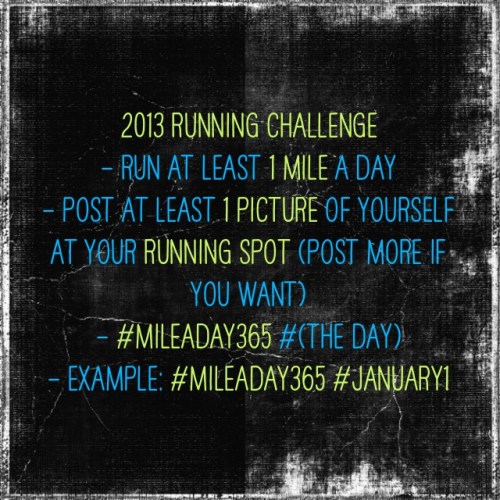
For some running inspiration, join us with this challenge:

IMG_2790

New Beginning(s): “This is the first day of the rest of your life . . . “

I feel like I am constantly starting over. Personally, starting over feels good to me, and I wake up nearly every day with the bridge of one of my favorite songs stuck in my head: “This is the first day of the rest of your life.” Sometimes, though, I think this might get draining for my friends. I think they sit around thinking, What is she going to try to do this time, and how long will it last? You know, I think the same thing. But instead of feeling like a flake or feeling defeated by my inability to “stick to it,” I feel invigorated by it. This may be wishful thinking, but I think starting new again and again and looking at every day as the first day of the rest of my life is actually a very healthy place for me to be in. I never get stuck in a rut, unless it is a rut of starting over. This constant change of focus, however, might mean that I never really finish what I start, which is a signal or indicator of failure in American culture that places so much emphasis on the completion of tasks, even at the face of incredible boredom or monotony. I, however, vow that each day is the first day of the rest of my life, and I retain the right to change my mind and to act out those changes in my little corner of the world.

How will this work out, you ask, in the facets of my life I hold most dear? Well, Friend, here’s today’s new and improved me (with a smattering of the old me for good measure, and a touch of the same old topics being knocked around again).

Anyone who’s read this blog before knows that one of my largest areas of struggle is spirituality. I reason with my analytical self and contemplate inside my mystic self, I wrestle with the (many understandings of) the Judeo-Christian God and, lately, I’ve been conversing with Buddhism. I’m also looking for ways intentionally fit in some meditation and prayer throughout my day. Providentially, I happened upon the Daily Examen, which is an Ignatian practice. I think this short simple prayer exercise will complement the other meditation I have started, “Breathing in, I calm my body. Breathing out, I smile. Dwelling in the present moment, I know this is a wonderful moment,” which I read about in Living Buddha, Living Christ by Thich Nhat Hanh. Thay, as his students call him, seems to be onto something that resonates inside of me when he compares mindfulness and meditation to the presence of the Holy Spirit and prayer. Never does he claim that they are one and the same, but he carefully describes the ways in which they can exist side-by-side to bring a further understanding of ourselves in line with a further understanding of the world and its spiritual realm. His writing is so beautiful and his spirit so kind and peaceful, it makes me want to visit Plum Village. I’m thinking about going there next summer if I can find the funding. I need a bit of renewed-ness in my life. Summer seems pretty far away, but I know it will be here before I know it.

Looking toward summer probably isn’t what a teacher should be doing while she sits at her desk spending time on personal writing before beginning to plan two first, six-week units for classes, but it’s what I am doing, and it’s necessary and good work, and looking toward summer is natural for me. However, the school year is here and brings with it many, many changes to our school. Most important to me is the change that enabled me to move to the high school. I am very sad to leave my middle school students and some of my middle school colleagues, but I am excited to embark on a new journey, “This is the first day . . ..” This year I am teaching two sections of British literature, which is new for me. I never imagined I’d teach British literature. I never thought I’d want to, but it’s part of the bargain of moving up to high school. I’m finding that I really enjoy planning for the class and thinking about something new and different to me. I’m also enjoying three sections of American literature, which is, of course, why I made the decision to move to high school. I love American literature. I love everything about it, and now I can restructure the course into thematic units and teach it in a more holistic, well-rounded way, giving more voice to those groups which are currently under-represented. At Burris, we’ve always taught it chronologically by literary movements, which is entirely the easiest way to teach it when two teachers are sharing the classes. However, it’s my own gig now, and I plan to switch things up for next year. This year, because I only have two preps and because we’ve been released from many of our committee requirements, I feel like I can squeeze in a few things that I thought might get squeezed out of my life.

One of the things I’m putting back into my life is my dissertation. This, I think, might be the thing that makes me seem the most flakey. To most, it likely seems that I don’t know what I am doing and I’m flighty and not very serious about this piece of my education, but I am. Very. Serious. I want to finish my PhD, but I don’t want my ideas, my paper, my writing to suck. I don’t want to be subpar, and that’s where I was headed. I’ve taken an entire summer off, rested, and refocused, and I am ready now to a superstar! (That was a little too much, eh?) At any rate, I have a plan this time, and it might actually work. I plan to get up and get to school by 5:30 every morning, giving myself two hours to work on my dissertation every day before school starts. My mind is the freshest at this time of day, and theoretical concepts make the most sense before I’ve intermingled with my students. I’m not a morning person in the way of being with people that early, but I can surely write and read before the chaos of the day clutters my brain. I have two hours of prep time to get things ready for classes throughout the day, and our lesson plans are due on Monday by 4PM anyway. I am really excited about this prospect, and now I can’t, simply can’t, fall on my face, or I will look like a real tool.

I’m also going to start taking piano lessons every other Friday, and, as of now, I’m a little nervous about that bit of exploration and learning!

What does this do for my swimming and running, my athletic endeavors, you might wonder. I’m canceling the rest of the races I had planned for this year, in favor of being a bit more low-key and doing some 5Ks as they come up. I’ve decided to put a hold on my morning swims. It’s going to be two school years of sacrifice, and then I can swim again. I doubt I’ll forget in that time. As far as biking goes, the season is almost over for it, and I don’t plan to bike on my trainer until spring. Until it is over, though, I plan to go on long rides on Saturday with Bec, and I ride my bike to school every day anyway. In order to sort of rein in my extra energy and balance my moods, I plan to combine the prayer and mediation I mentioned above with an evening run to wind down from and reconsider my day. It’s my goal, Monday through Thursday, to walk over to the lookout by Minnetrista and do the smiling and mindful meditation, then run two miles. When I return to the overlook, I will then complete the daily examen and walk home. There is no reason that I can’t have an hour to myself to be contemplative before going home to cook.

I plan to continue to cook delicious—I’d even say gourmet (sometimes)—paleo meals. We feel better and look better in just the nine months we’ve been eating grain-free. I hope to keep it that way. Also, my brother and I want to eventually open a paleo gastro pub with our own home-brewed hard ciders. We’re going to start brewing the ciders this fall, I think, and we’re hoping to make some pear cider next fall. One thing we both love is trying new foods and drinks, so I think it’s a bonus that we found paleo eating when did!

Cheers! (Raising a hard cider): here’s to starting over. Here’s to rethinking. Here’s to new beginnings. Here’s to exploration, and growth. Here’s to future hopes, past failures and success, and present moments to savor. Here’s to “the first day of the rest of your life. Even in the darkness you can still see the light.”

Please Don’t Drop Over . . . But I Wrote Something

Summer is here and with it comes my renewed sense of who I am. I know I am cyclic; I think who I am follows a certain strange circadian rhythm. (Incidentally, I just discovered through a quick Wikipedia accidental search that I might be the lucky owner of a circadian rhythm sleep disorder.) No, it’s more than simply a circadian rhythm; my body follows a seasonal rhythm as well. I frequently look back through my blog posts to see what I was thinking about in previous years and previous months. Sometimes the blog posts from the same weeks in different years are surprisingly similar. With the exception of last summer, which I believe to be the darkest night of my soul, summer is usually a time of growth, joy, freedom, and redefinition for me. I am most likely to start a diet, an exercise program, or some new venture in the summer. I grow restless and get a sense of wanderlust when the weather gets hot. This summer has been no exception.

I began eating Paleo/Primal in January of this year, so my diet had already changed considerably. I haven’t once looked at paleo/primal as “a diet,” so it’s been much easier to continually eat this way. Also, I have noticed that I am intolerant of most of the food I was shoveling into my face as a vegan. I can’t eat corn (serious diarrhea). I can’t eat wheat (bloating, hives, mouth reaction). I can’t eat soy (serious hot flashes). And I can’t eat much dairy (tired muscles and achy joints). The dairy, though, is typically the cheat. I can’t get enough Ben & Jerry’s Chunky Monkey. It’s almost paleo/primal, right? Right?! I find that if I stick to eating whole, clean foods like meats and fishes, coconuts, nuts, eggs, vegetables, fruits, fermented ciders, and sparingly using raw honey and maple syrup, I feel so much better.

The side benefit of eating this way, for me, is never having to count calories, always having lots of energy, always having food options that appeal to me, and feeling full with very few low-blood-sugar moments. When I was vegan, I felt good, but never amazing, because I always felt just a little tired. I couldn’t easily go out to eat with friends, unless I wanted to be a total pain or my friends were also vegetarian or vegan. I found myself counting calories, because many processed vegan foods can get really caloric really fast. I counted calories, too, because I could never get full. No worries about feeling full with paleo/primal eating. I can eat breakfast and not be hungry again until dinner.  When I was vegan, my blood sugar would drop at least twice a day to the point where I was really grumpy and lightheaded. Also, as a vegan I always missed eating meat. I haven’t, not one time since I’ve been paleo, found myself fantasizing about a black bean burger or a slab of tofu, though they are both enjoyable. Frequently, when I was vegan, I would desire ribs or a burger or a salmon steak.

Basically, I feel like I’ve moved into a new life and life more abundantly. I’m still not cool with factory farming, and I never will be. I try to get all local, grass-fed meat and eggs and wild-caught fish, paying close attention to the ways the animals are raised, harvested, and slaughtered. This is the consolation I make for taking another life, which I still feel is sacred. This facet is the most difficult for me about paleo/primal, but I feel so much better I don’t ever want to look back. And, from my fattest point three years ago (256.4 pounds) I have lost 46 pounds total, but just from this January, I have lost 30 of those pounds. My pants size has dropped three sizes, and I bought my first pair of Calvin Klein shorts at Marshall’s when I was in Florida. I can run, bike, and swim with much more ease and speed. It’s really refreshing and beautiful.

I have set two new goals for myself: run a trail marathon by the time I am 40 (July of 2014), and complete a triathlon of some length by the time I am 39 (July 2013). Summer affords me the time and light to get in a lot of exercise, which may be why my mood gets so much better. Every morning I get up at 5:30 or 6 and either run to the pool and swim a couple of miles, or ride my bike 20-ish miles. This summer I decided to do two-a-days, which include ab exercises or kettle bell workouts in the afternoons. I find myself doing circuits, hoping to add in other body-weight exercises. I’m a big fan of minimal equipment. Today, as I sit here writing this, my abs are still on fire from the medicine ball workout I did on Monday, but I’ve read enough to know that you’re abs can take some punishment. Every day punishment, so I plan to carry-on this afternoon before joining the summer solstice bike ride that leaves from Pita Pit this afternoon. I also play disc golf, because I can and because it’s fun.

I know.

I sound like a total meat-head who can only talk about diet and exercise, but I consider those to be two of four basic building blocks of my life. Diet. Exercise. Spirituality. Intellect.

Another basic building block is my faith. Summer gives me time and inspiration to devote to spending intentional time with God. As I did with Lent, I am utilizing Common Prayer to facilitate my morning worship and prayer time. I take great comfort in the ritual of liturgy and prayer, and I find I can connect more completely, more fully with God, when I structure my prayer as a call and response with the refrain, “Lord, hear my prayer.” In my prayers, then, I can be as specific or as general with my words as I want to be, and the words, “Lord, hear my prayer,” feel as if they reassure me that God can hear my thoughts about that topic without my having to verbalize them. There are many things I pray, that I am not sure I would know how, or feel comfortable, verbalizing, even just to God, who I have been told already knows my thoughts.

As a child, I couldn’t see the value of prayer if God is unchangeable and if God already knows my thoughts. What’s the point? Now it seems to me that the point is much like speaking to a psychologist, and sometimes I can think/speak through my own problems or think/speak my own joys much like I would to a friend. Sometimes simply doing that makes it feel as if God is answering, and maybe that is the answer. Maybe we aren’t really changing God’s mind, but our own. Maybe we aren’t hearing a tangible answer from God, but we are instead somehow coming around to an answer. Perhaps this is how many people make decisions where God’s will looks a lot like their own will. I’m not sure. I’m just knocking around some skepticism/cynicism. Sometimes as Christians, I think we like to have things both ways: God is unmoveable, but we can move God through prayer, and we want God to be constant, but we want God to save someone’s life or change an outcome. In fact, we sometimes beg. It’s interesting is all I’m saying. I haven’t lost my faith, I just have lots of questions.

I have also added into my quiet time the discipline of reading through the book of James each day. Once I feel as if I have most of its truths committed to my soul, I will choose another book, though there aren’t many short enough to read in their entirety each day. I may have to read a few chapters each day or something. I started with James because of its practicality and because it seems to be an outlier about some pretty heavy theological concepts, like faith and works, speech, and prayer. I like James for his candor and for his perspective. He’s not Paul, and I love that about him.

I think when I am grounded in my faith, my relationships get better. I lump family, friends, and my love into this building block of spirituality. It all rolls together for me. When I am fully centered and fully contemplative of God, my faith, the Church, the way I deal with people is much more grace-filled, much more holy, much more compassionate. I can’t give love that I am not allowing myself to take from God. When I center in God, pursue God, my relationships fall in line and become more fulfilling, more of a blessing, and less like work. Summer is a time to nurture those relationships.

Finally, feeding my intellect is something that I have to do to feel like all is right with the world. Sometimes I feel like I go into a nine-month-long hibernation during the school year. I get up. I teach. I come home. I plan. I grade. I go to bed. If I am lucky, I add in some exercise or socialization. But, during the summer, I get to do whatever I want, whenever I want, and I even have time to read. I read a lot during the summer. It’s my goal to read at least two books each week: one fiction and one nonfiction. So far, I am on schedule. I love learning new things, and my favorite way to do it is by reading, especially since it’s become real again.

So, yeah. Summer. Love.

“Come alive, come truly alive!”

I’ve just started reading Living Buddha, Living Christ by Thich Nhat Hanh. The introduction is written by Elaine Pagels, whose book about “Revelation” is also on my to read list. In the introduction of Living, she discusses some of the gnostic gospels and their similarities to Buddhist thought. Most striking for me are the words of “The Teaching of Silvanus”

Knock upon yourself as upon a door, and walk upon yourself as on a straight road. For if you walk on that path, you cannot go astray; and when you knock on that door, what you open for yourself shall open.

Pagels argues that the gnostic gospels point not simply to faith, but also to a “path of solitary searching”  for understanding (xxv). For obvious reasons, many early church leaders condemned the gnostic gospels and the alternate salvific paths they taught, but these same books advocate similar theological teachings, such as compassion. Pagels writes that in the “Gospel of Thomas” Jesus says, “Love your brother as the apple of your eye.” Isn’t that the same thing as recognizing the spark of the divine in everyone or loving your neighbor as yourself?

In the first chapter “Be Still and Know,” Nhat Hanh advocates a similar idea to Paul’s in the biblical text. Paul writes in Acts: “‘For in him we live and move and have our being.’As some of your own poets have said, ‘We are his offspring.’We also learn throughout the Christian scriptures that every good thing comes from God. Take the first chapter of James for example: “Every good and perfect gift is from above, coming down from the Father of the heavenly lights, who does not change like shifting shadows.” St. Thomas Aquinas, in his ginormous text Summa Theologica, even extrapolates the idea that all good is of God. Nhat Hanh agrees with this long line of Christian theological thought, but spins it little when he writes about his own encounters with Jesus: “We have to allow what is good, beautiful, and meaningful in the other’s tradition transform us” (9). Nhat Hanh and early Christian writers of all threads, I think, want us to realize this singular spirit of love, beauty, and grace.

I like the last section of this first chapter quite a bit. Nhat Hanh advocates that we should look deeply, which means that “the distinction between observer and observed disappears” (11). Do you suppose this is what Jesus meant when he said, “I am the vine; you are the branches. If you remain in me and I in you, you will bear much fruit; apart from me you can do nothing”? Are we to look into Jesus so intently that we become indistinguishable from him? Is that how we can learn to change the world?

Peace.